
How to Avoid Allergens in Supplements
Hidden allergens in supplements can cause serious health issues, from mild skin reactions to severe anaphylaxis. To stay safe, you need to know how to spot these allergens, even when they’re disguised under technical names or hidden in additives. Here’s a quick breakdown:
- Common allergens like milk, soy, fish, eggs, wheat, peanuts, tree nuts, shellfish, and sesame must be labeled under U.S. law.
- Hidden sources include whey (milk), soy lecithin, fish oil, wheat starch, or egg albumin.
- Additives like carmine, annatto, and sulfites can also trigger reactions and may require extra scrutiny.
- Label reading is key. Learn alternative names for allergens and check for "Contains:" statements or advisory warnings.
- Use tools like SlipsHQ to scan barcodes and quickly identify allergens in products.
Always choose supplements with clear labeling, third-party testing, and allergen-free certifications. For severe allergies, consult your doctor before trying new products.
Step 1: Identify the 9 Major Allergens and Their Sources
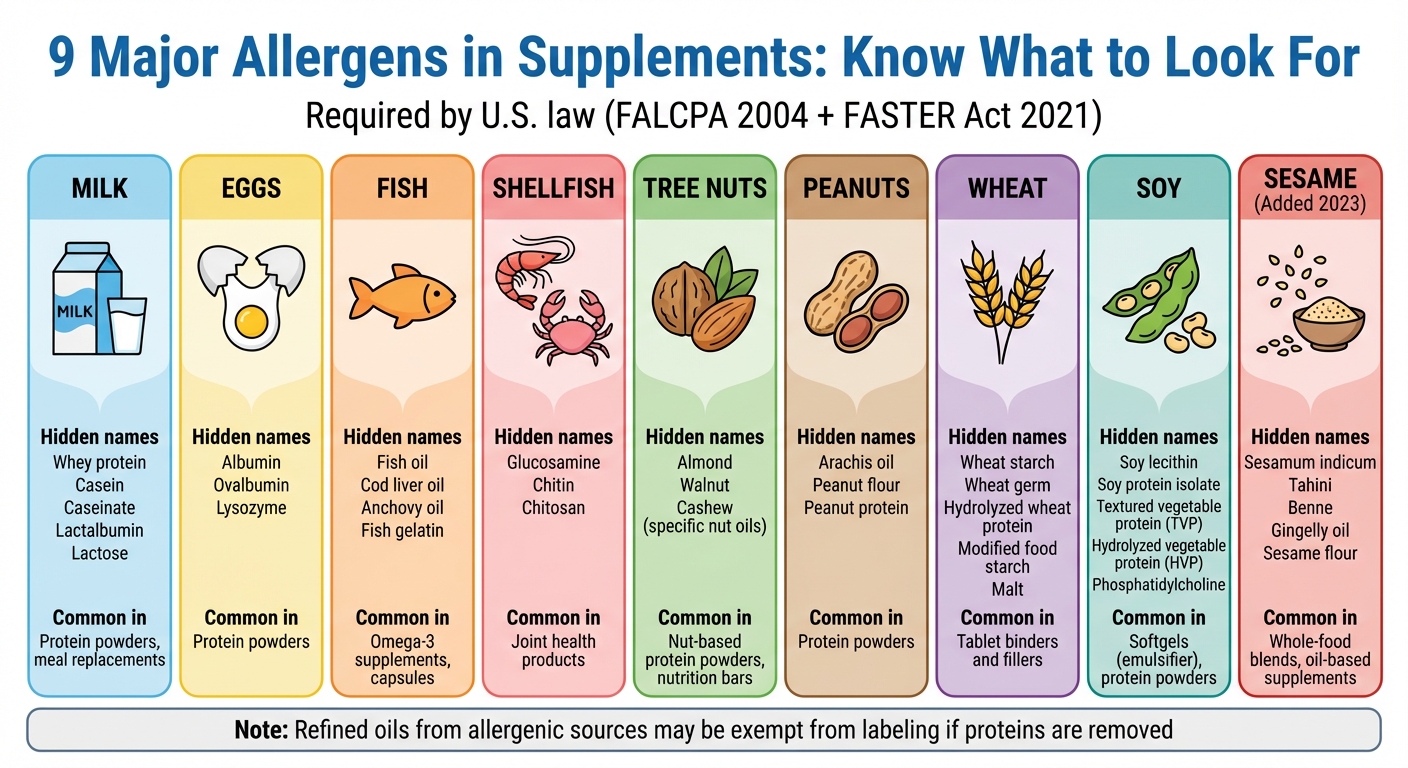
9 Major Allergens in Supplements and Their Hidden Names
Understanding allergens is a crucial first step in creating a safe supplement routine.
The 9 Major Allergens Under US Regulations
In the U.S., there are nine major allergens that must be clearly listed on dietary supplement labels: milk, eggs, fish, crustacean shellfish, tree nuts, peanuts, wheat, soybeans, and sesame. Originally, the Food Allergen Labeling and Consumer Protection Act (FALCPA) of 2004 identified eight allergens, with sesame being added as the ninth in 2021 through the FASTER Act, which took effect in 2023.
These rules apply to supplements just as they do to regular food products. If any of these allergens are part of the formula - whether as an active ingredient or as a filler, binder, or coating - they must be listed on the label. It's also important to recognize how these allergens might appear under less obvious names in ingredient lists.
Common Supplement Ingredients Containing Allergens
Allergens often hide behind technical ingredient names in supplements. For example:
- Milk might show up as whey protein, casein, caseinate, or lactose, especially in protein powders and meal replacements.
- Soy can appear as soy protein isolate, soy lecithin (used as an emulsifier in softgels), or textured vegetable protein.
- Fish is often found in omega-3 supplements as fish oil or fish gelatin capsules, while crustacean shellfish is a common source of glucosamine, which is extracted from shrimp or crab shells and used in joint health products.
- Wheat might be listed as wheat starch, wheat germ, or hydrolyzed wheat protein, frequently used in tablet binders and fillers.
- Eggs may appear as egg albumin, ovalbumin, or lysozyme, particularly in protein powders.
- Tree nuts like almonds, walnuts, or cashews are common in nut-based protein powders and nutrition bars, while peanuts might be included as peanut flour or peanut protein.
- Sesame, now officially recognized as a major allergen, may be listed as sesame oil, tahini, or sesame flour in whole-food blends or oil-based supplements.
It's worth noting that refined oils made from allergenic sources, such as soy or peanuts, are sometimes exempt from allergen labeling if the refining process removes most of the proteins that trigger allergic reactions. However, this exemption doesn't cover all cases, so reaching out to manufacturers for clarification is a wise step when ingredient sources are uncertain.
Step 2: Read Labels to Find Hidden Allergens
Once you've identified allergens to avoid, the next challenge is spotting them on supplement labels. Sometimes, allergens are listed under technical or less familiar names, making it tricky to recognize them. Let’s break down how to identify these hidden ingredients and navigate labels effectively.
Technical Terms That May Mask Allergens
Allergens often appear under scientific or alternative names. For instance:
- Milk could be listed as casein, caseinate, whey, lactalbumin, or lactose.
- Eggs might show up as albumin, ovalbumin, or lysozyme.
- Wheat may be labeled as wheat starch, modified food starch (if wheat-derived), malt, or hydrolyzed wheat protein.
- Soy is sometimes listed as soy lecithin, textured vegetable protein (TVP), hydrolyzed vegetable protein (HVP), or phosphatidylcholine.
- Fish could appear as cod liver oil, omega-3 fish oil, anchovy oil, or specific species like pollock or tuna.
- Shellfish might be present as glucosamine (from shrimp or crab shells), chitin, or chitosan.
- Peanuts can be labeled as arachis oil or peanut flour.
- Tree nuts are often identified by specific names like almond, walnut, cashew, or their oils.
- Sesame might appear as sesamum indicum, tahini, benne, or gingelly oil.
While U.S. law requires common allergen names to be stated somewhere on the label, learning these technical terms adds an extra layer of vigilance.
FDA Allergen Labeling Rules
Under the Food Allergen Labeling and Consumer Protection Act (FALCPA) and the FASTER Act, supplement labels must clearly disclose the nine major allergens. This can be done either by including the allergen’s common name in parentheses next to the ingredient (e.g., "albumin (egg)") or in a "Contains:" statement. Look for these declarations right after the "Other Ingredients" section on the Supplement Facts panel - this is often the quickest way to identify major allergens.
Hidden Risks in Fillers, Flavors, and Additives
Even beyond the required allergen disclosures, fillers, flavors, and additives can be sneaky sources of allergens. Pay close attention to the "Other Ingredients" section, as it may include potential triggers not listed as part of the active formula.
- Fillers and binders like whey powder, lactose, milk protein isolates, wheat starch, and maltodextrin (if derived from wheat) can pose risks for those allergic to milk or wheat.
- Capsule materials may be made from bovine, porcine, or fish sources, which is crucial to know for individuals with related allergies.
- Emulsifiers such as lecithin are often derived from soy or egg. While soy lecithin has low protein content and typically causes fewer reactions, those with egg or soy allergies should still review these ingredients carefully.
- Flavoring agents like "natural flavors" or "artificial flavors" may hide allergens such as milk, soy, or nuts. If these contain one of the nine major allergens as a protein source, it must be disclosed (e.g., "natural flavors (milk)") under FALCPA. For non-major allergens, however, disclosure isn’t always required, so contacting the manufacturer for clarification can be helpful.
Certain color additives and preservatives also warrant extra caution:
- Carmine or cochineal extract, derived from insects, can cause severe allergic reactions such as anaphylaxis, contact dermatitis, or hives. These must be declared by name on labels.
- Annatto, a natural coloring from Bixa orellana seeds, has been linked to hives, swelling, and even anaphylaxis in sensitive individuals.
- Tartrazine (FD&C Yellow No. 5), while rare, can trigger hives in some people. The FDA requires it to be listed specifically by name.
- Sulfiting agents like sodium metabisulfite, sodium bisulfite, and potassium bisulfite can provoke asthma or other reactions in sensitive individuals. These must be disclosed if present at or above 10 parts per million.
Interestingly, a 2020 study revealed that 62% of children with atopic dermatitis had positive patch tests to at least one food-additive allergen, compared to 20% of children without the condition. Common culprits included azorubine (24.4%), formic acid (15.6%), and carmine, cochineal red, and amaranth (13.3% each). If you have a history of reactions to dyes or preservatives, carefully check labels for these specific names and consider choosing dye-free or preservative-free products whenever possible.
Step 3: Use Apps to Detect Allergens Quickly
Checking labels manually can be time-consuming and error-prone. Barcode-scanning apps offer a faster, more reliable way to pinpoint allergens and harmful additives. Tools like SlipsHQ make identifying potential risks in supplements a breeze.
How SlipsHQ Helps You Avoid Allergens
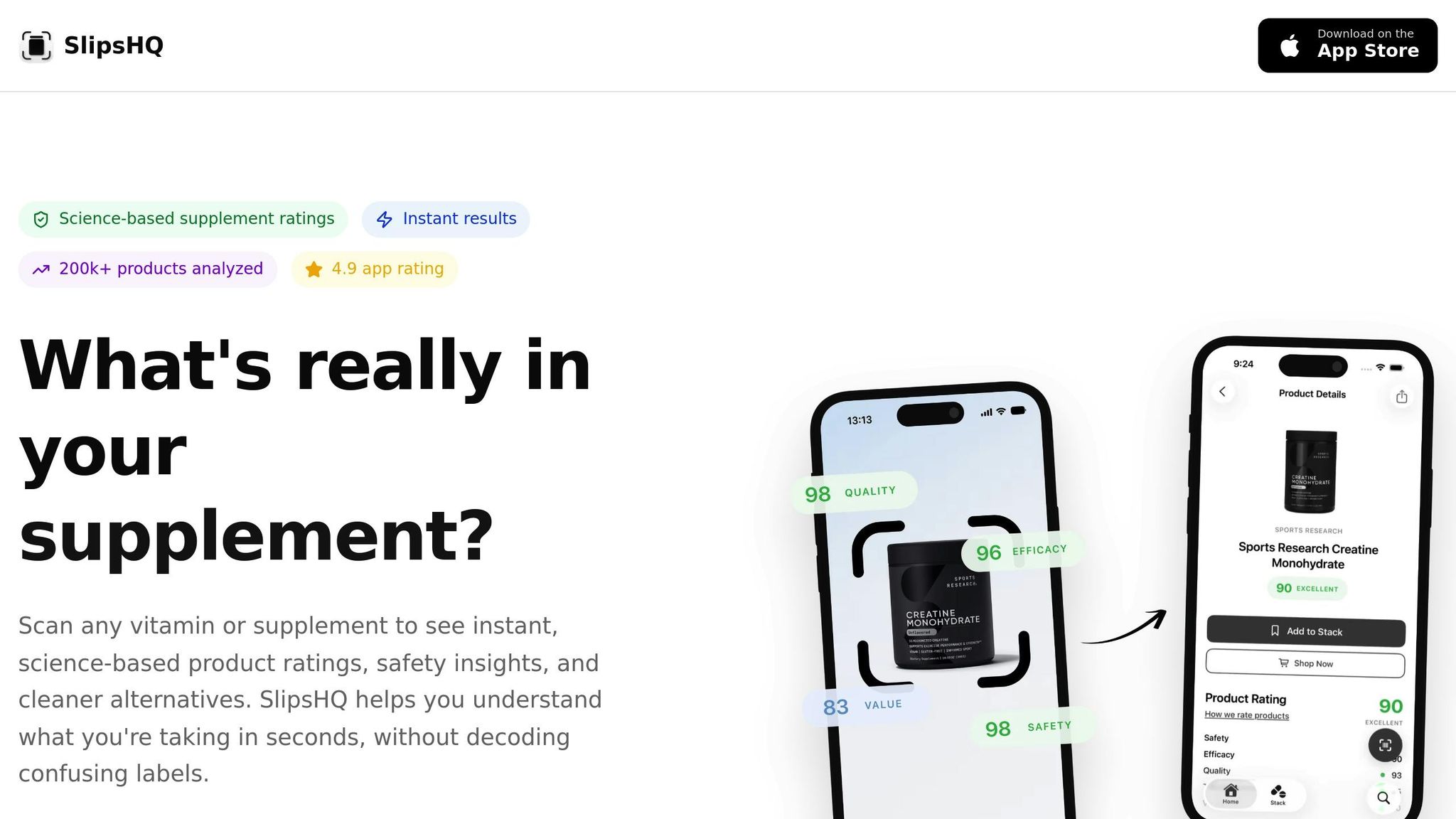
SlipsHQ simplifies allergen detection with its instant barcode scanning feature. By scanning a product's barcode, you can quickly access a detailed ingredient list and identify potential allergens. For instance, if a multivitamin contains barley malt (a possible gluten source) or if a fish oil supplement includes shellfish-derived contaminants, the app immediately alerts you with clear safety warnings.
The app’s database cross-references every ingredient against known allergens and additives. It even differentiates between highly refined oils, which are often exempt under FDA regulations, and less refined versions that may still pose risks. With a database covering over 200,000 supplements, including major brands and categories, SlipsHQ ensures you have the information you need to make safer choices.
Additionally, SlipsHQ doesn’t just stop at flagging allergens - it provides a deeper layer of insight through science-based trust scores.
Using Science-Based Trust Scores for Safety
SlipsHQ evaluates supplements using a 35-point system that generates a trust score ranging from 0 to 100. This score reflects key factors like safety, efficacy, quality, transparency, and value. Under the Safety category, products are penalized if they contain any of the nine major allergens or undeclared traces, such as soy, nuts, or shellfish derivatives often found in fillers. Products with clear labeling, third-party testing, and minimal unnecessary additives tend to score higher, giving you a quick way to identify safer options.
You can also customize your allergy profile within the app. This feature automatically flags supplements that align with your needs and recommends safer, allergen-free alternatives. By combining rigorous evaluation with a personalized approach, SlipsHQ helps you confidently choose supplements that fit your health requirements.
Step 4: Select Allergen-Free Supplements
When it comes to choosing allergen-free supplements, focus on trusted certifications, thorough testing, and personalized recommendations to ensure safety and effectiveness.
Look for Allergen-Free Certifications
Certifications from third-party organizations add an extra layer of confidence. For instance, a Certified Gluten-Free seal ensures the product contains less than 20 parts per million (ppm) of gluten - key for those avoiding wheat. Similarly, the Non-GMO Verified label guarantees the absence of genetically modified ingredients like soy. Certifications from NSF International, such as Contents Certified or Certified for Sport, confirm that the product has gone through rigorous testing to rule out undeclared allergens. These certifications not only address the nine major allergens (milk, eggs, fish, shellfish, tree nuts, peanuts, wheat, soy, sesame) but also check for cross-contamination during manufacturing. This kind of assurance goes beyond basic compliance, giving you peace of mind.
Choose Third-Party Tested and Transparent Brands
Third-party testing is crucial for verifying that manufacturing processes effectively prevent cross-contamination. Organizations like NSF and USP ensure allergen levels stay below 10 ppm thresholds. Transparent brands stand out by openly sharing their supply chain details, providing certificates of analysis, and using allergen-controlled facilities. They avoid ambiguous terms like "natural flavors" and instead clearly disclose which of the nine major allergens their products exclude. This level of transparency helps you make informed decisions.
Build Your Allergen-Free Supplement Routine
Once you've identified certified and tested products, it's time to create a supplement routine tailored to your specific allergen needs. Start by pinpointing the allergens you must avoid and introduce one supplement at a time to observe how your body reacts.
The SlipsHQ app simplifies this process. Its personalized stacks feature recommends alternative supplements with high trust scores and helps you compare prices across retailers. By keeping all your supplement data in one place, the app makes it easier to fill nutritional gaps while avoiding hidden contaminants. Additionally, its emphasis on transparency ensures you know exactly how brands source ingredients and conduct testing. This approach allows you to build a supplement routine that's not just effective but also backed by reliable science, keeping your health protected at every step.
Conclusion
Steering clear of allergens in supplements requires a thoughtful and systematic approach. Familiarity with the major U.S. allergens mentioned earlier is key, as proteins derived from these allergens can show up in everything - from omega-3 capsules to protein powders and vitamin D tablets.
Always read the ingredient list and "Contains:" statements carefully. Formulations and suppliers can change, so it's important to check every detail. Review the full ingredient list, including fillers, binders, flavors, and colorants. Pay close attention to advisory warnings like "manufactured in a facility that also processes peanuts or tree nuts", especially if you’re prone to severe allergic reactions. Ingredients such as carmine, annatto, and sulfites, which pose higher allergy risks, are required to be clearly listed .
Leverage technology to make things easier. Tools like SlipsHQ can help you quickly scan products for allergens and additives. With features like science-backed trust scores and ingredient purity data, these tools allow you to compare brands and find options that align with your allergy needs and budget - without having to decipher every label manually.
Opt for products with clear allergen labeling and credible certifications. Look for seals like "Certified Gluten-Free" or other allergen-free certifications, which often indicate stricter control over ingredients and manufacturing processes. Trustworthy companies usually provide detailed allergen information, lot-specific testing results, and accessible customer support - going beyond the standard FDA requirements. If a label is unclear or incomplete, it’s best to consider it a warning sign.
To tailor your supplement choices even further, consult your healthcare provider. For individuals with a history of anaphylaxis or multiple allergies, discussing new supplements with an allergist or physician is essential. They can identify specific sensitivities and suggest safer alternatives, such as algae-based omega-3s instead of fish oil or pea protein in place of whey. This ensures you can meet your nutritional needs without compromising safety. With careful label reading, smart tools, and reliable brands, navigating supplement use with allergies is entirely possible.
FAQs
How can I spot hidden allergens in supplement ingredients?
To spot hidden allergens in supplements, start by closely examining the ingredient list. Watch out for common allergens like soy, dairy, gluten, or nuts. Also, be mindful of less obvious culprits such as artificial fillers, preservatives, or vague terms like "hydrolyzed protein" (which might contain gluten) or "natural flavors" (which could hide allergenic ingredients).
For a quicker and more thorough check, consider using SlipsHQ. This app lets you scan a product's barcode to get a detailed breakdown of its ingredients, highlights potential allergens, and flags any safety concerns. It’s a handy tool to make smarter, safer choices effortlessly.
What ingredients in supplements could cause allergic reactions?
Some supplements may include additives and fillers that can cause allergic reactions. These often involve artificial colors, preservatives like parabens, artificial sweeteners, and flavoring agents. There’s also the risk of stabilizers or fillers derived from allergens such as soy, dairy, or gluten.
To minimize risks, take the time to carefully review ingredient labels. Pay close attention to potential allergens and steer clear of products with ambiguous terms like "natural flavors" or "proprietary blends" unless the sources are clearly identified. For extra reassurance, tools like SlipsHQ can assist in analyzing product labels, helping you spot potential allergens quickly and effectively.
How can I use technology to identify allergens in supplements?
Technology has made it simpler than ever to steer clear of allergens in supplements, offering quick and reliable tools to help you stay informed. Take SlipsHQ, for example - it lets you scan supplement barcodes to instantly access detailed ingredient lists, safety warnings, and alerts for any potential allergens.
On top of that, features like science-backed trust scores and tailored recommendations mean you can pick products that fit your health needs without worrying about allergens. This efficient process not only saves time but also helps you make well-informed choices with confidence and ease.