
How to Check Supplement Labels for Allergens
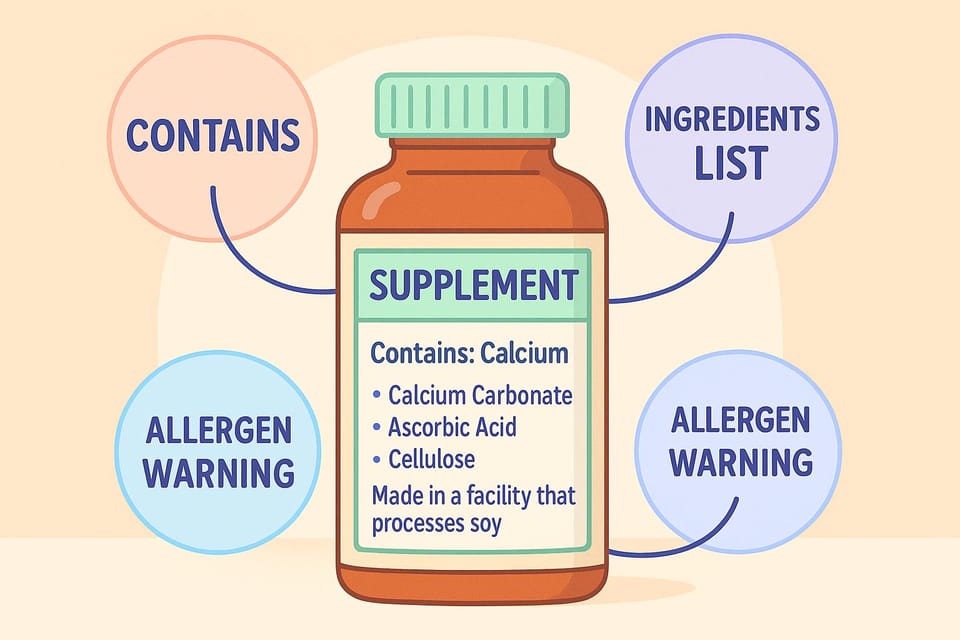
If you have food allergies, you must read supplement labels carefully to avoid hidden allergens. Allergens often hide in inactive ingredients like fillers, binders, or flavorings, and even trace amounts can cause severe reactions. Here’s how to check labels effectively:
- Start with the front label: Look for claims like "dairy-free" or "gluten-free", but don’t rely on these alone.
- Check the "Contains" statement: This bolded section lists the nine major allergens (e.g., milk, eggs, wheat, soy, sesame).
- Read the full ingredient list: Look for allergens under technical names like whey (milk) or soy lecithin.
- Scan for cross-contact warnings: Phrases like "may contain" or "processed in a facility with" indicate possible contamination.
- Use tools like SlipsHQ: Apps can scan barcodes to flag allergens and hidden ingredients quickly.
Always double-check with manufacturers for details not listed on the label, like cross-contact risks or cleaning procedures. Labels can change without notice, so stay vigilant.
Where to Find Allergen Information on Labels
Front Label vs. Back Label
When it comes to supplement bottles, there are two main areas to check: the front label (also called the principal display panel) and the back or side label (known as the information panel). The front label typically highlights the product name, brand, net contents, and marketing claims like "dairy-free" or "gluten-free." While these statements can provide helpful hints, they’re usually just marketing language and may not tell the full story about allergens.
For the most accurate information, flip the bottle over to the back or side label. This is where you’ll find the Supplement Facts box, the full ingredient list, and any "Contains" allergen statements or warnings. U.S. law requires manufacturers to clearly disclose the nine major allergens in this section. So, if you want to know exactly what’s in the product, don’t rely on the front label - check the information panel instead.
Which Label Sections to Check
Once you’re looking at the information panel, there are a few key areas to focus on. Start with the "Contains" statement, which is usually bolded and lists major allergens. This is a quick way to identify if the product contains something you need to avoid.
Next, carefully read the full ingredient list, including any fillers or binders. Sometimes allergens appear under less obvious names, like whey (milk), soy lecithin, or fish gelatin. The Supplement Facts panel might also include details in parentheses, such as "protein (as whey) (milk)" or "Vitamin D (from fish oil)." Lastly, look for warning phrases like "may contain [allergen]" or cross-contact notices. These warnings, while not legally required, are crucial for anyone with severe sensitivities, as they indicate the possibility of unintentional allergen exposure during manufacturing.
Using SlipsHQ to Check Allergens Quickly
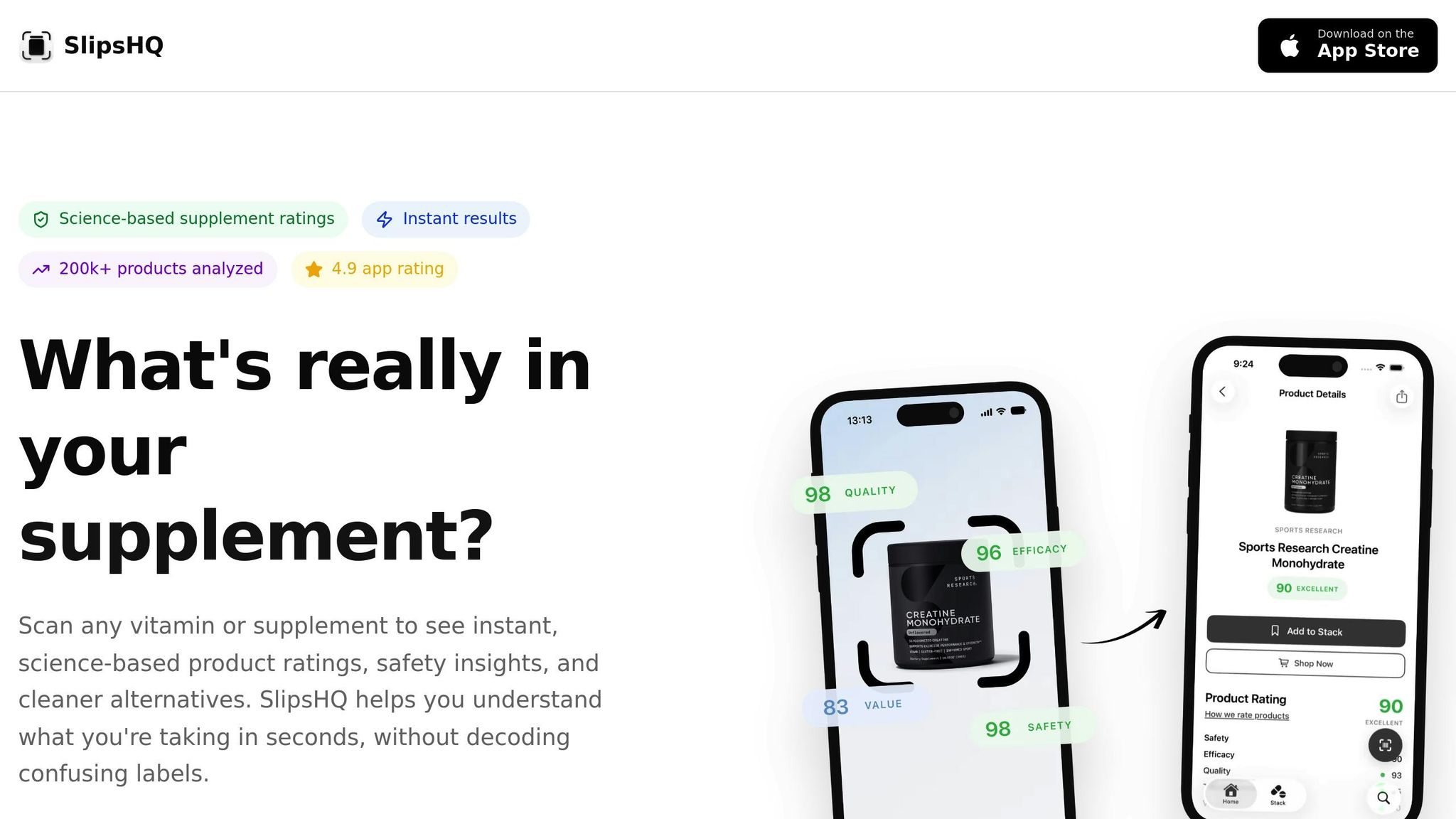
Manually reviewing labels can be a tedious process, but technology can make it easier. SlipsHQ is a tool that scans product barcodes and provides a clear breakdown of ingredients, allergen alerts, and safety warnings. It’s a fast, accurate way to identify potential risks without having to decipher every detail on the label.
With SlipsHQ, you can save your personal allergen profile - whether it’s dairy, shellfish, peanuts, or something else. Once set up, every scanned product is categorized as "safe", "use caution", or "avoid" based on your specific sensitivities. This feature is incredibly useful when comparing multiple products or dealing with labels full of complex terms. In just seconds, SlipsHQ transforms confusing ingredient lists into an easy-to-read summary, helping you make informed decisions before buying or using a supplement.
How to Check Supplement Labels for Allergens
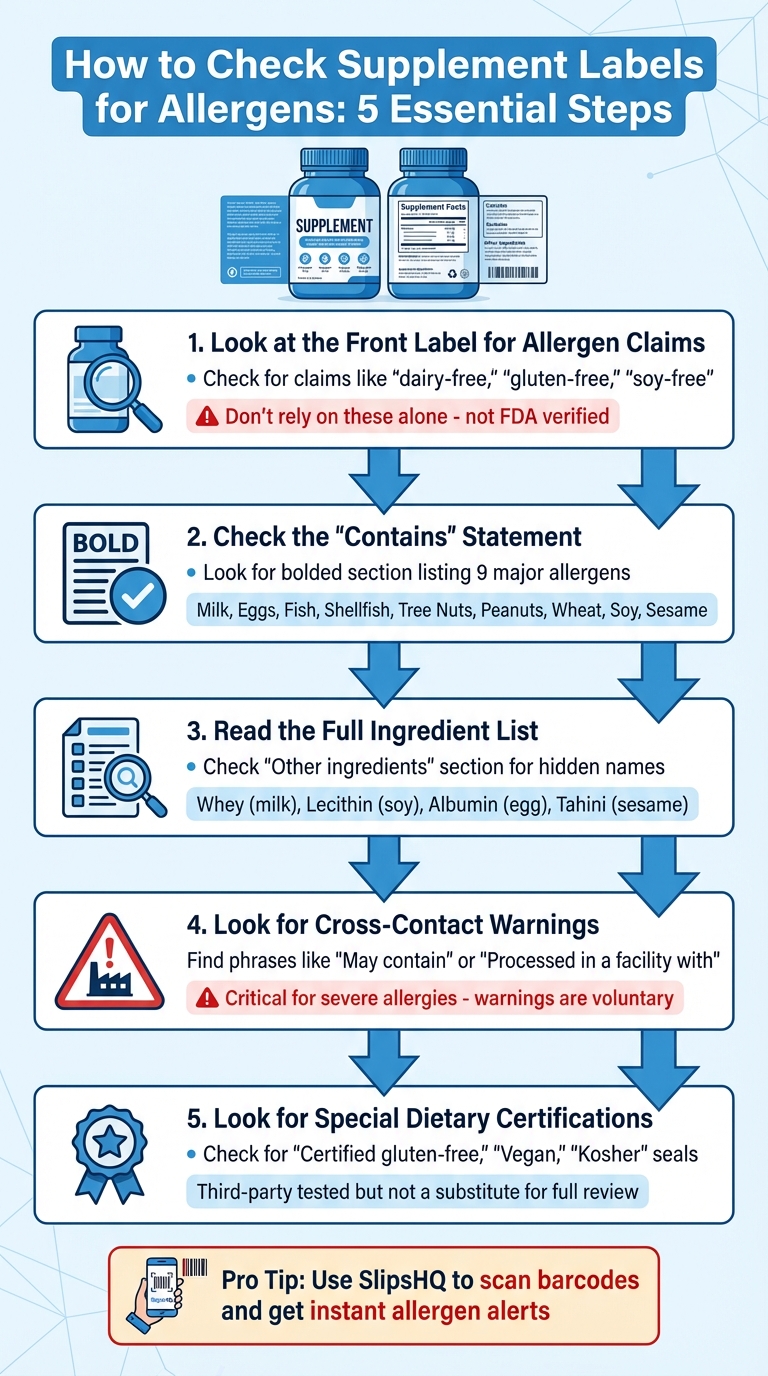
5-Step Process to Check Supplement Labels for Allergens
Ensuring a supplement is free from allergens requires a thorough review of its label. Here’s how to approach it step by step:
Step 1: Look at the Front Label for Allergen Claims
Start with the front of the bottle, also known as the principal display panel. Look for claims like "dairy-free", "gluten-free", "soy-free", or "allergen-free." While these statements can be helpful, it’s important to know that in the U.S., manufacturers aren’t required by the FDA to test every batch to confirm these claims.
Even if a product is labeled as "allergen-free", it might still be made in facilities that handle allergens, which can lead to cross-contact. Treat these claims as a general guide, but always dig deeper by reviewing the Supplement Facts box, ingredient list, and allergen statements on the back or side of the packaging.
Step 2: Check the "Contains" Statement
Next, examine the detailed information panel for a "Contains" statement. This is typically a bolded line that begins with "Contains:" followed by any of the nine major allergens recognized in the U.S.: milk, eggs, fish, crustacean shellfish, tree nuts, peanuts, wheat, soybeans, and sesame. For example, a whey protein product might state "Contains: Milk, Soy", or a fish oil capsule could list "Contains: Fish (anchovy, sardine)."
This statement is your quickest way to identify if the product is unsafe. If your allergen is listed, you’ll know immediately to avoid it. If it’s not listed, move on to the full ingredient list to check for hidden allergens.
Step 3: Read the Full Ingredient List
Carefully go through the complete ingredient list, including the "Other ingredients" section. Allergens can sometimes be listed under technical or less familiar names. For instance:
- Milk might appear as casein, whey, or sodium caseinate.
- Eggs could be labeled as albumin or lysozyme.
- Soy might show up as lecithin or textured vegetable protein.
- Sesame could be listed as tahini or benne.
Pay special attention to fillers, binders, capsule shells, and flavorings, as these can also hide allergens. Some ingredients may include clarifications in parentheses, such as "protein (as whey) (milk)" or "Vitamin D (from fish oil)", providing additional clues. Once you’ve reviewed these details, proceed to check for cross-contact warnings.
Step 4: Look for Cross-Contact Warnings
Scan the label for warnings like "May contain [allergen]", "Produced in a facility that also processes [allergen]", or "Manufactured on shared equipment with products containing [allergen]". These are voluntary warnings indicating that trace amounts of an allergen could be present due to shared manufacturing processes.
If you have a severe allergy, such as an IgE-mediated reaction, many allergists recommend avoiding products with "may contain" warnings for your allergen, especially when safer options are available. For milder intolerances or non-IgE reactions, the risk may be lower, but it’s always best to consult your healthcare provider. Keep in mind that the absence of a warning doesn’t guarantee the product is free from cross-contact.
Step 5: Look for Special Dietary Certifications
While checking for allergens, take note of any dietary claims or certifications such as "certified gluten-free", "vegan", "vegetarian", or "kosher." Certified seals, often backed by third-party testing, offer additional reassurance. For example, a "certified gluten-free" seal ensures the product contains less than 20 parts per million of gluten.
However, these certifications are not a substitute for a careful label review. A product labeled "vegan" might not contain animal-derived ingredients but could still be processed in a facility that handles allergens.
How to Spot Hidden Allergen Sources
Common Hidden Names for Allergens
Even with clear labeling laws in the U.S., allergens can often hide behind unfamiliar or technical names. While the nine major allergens must be disclosed, they don’t always appear in straightforward terms. Recognizing these hidden names can help you avoid potential risks.
For example, milk might be listed as casein, sodium caseinate, whey, lactalbumin, or even ghee. Egg can show up as albumin or lysozyme. Soy often appears under names like soya, soy lecithin, textured vegetable protein (TVP), miso, natto, shoyu, or tamari. Wheat might be disguised as farro, semolina, spelt, graham flour, malt, or food starches. Sesame could be labeled as tahini, benne, gingelly, sesamol, or sim sim.
When it comes to fish and crustacean shellfish, specific names such as cod, salmon, or tuna are common, but you might also encounter terms like fish oil or omega-3. Shellfish allergens may appear as shrimp, crab, lobster, or even glucosamine, which is typically derived from shellfish. Peanuts might be labeled as goobers, groundnuts, or nut meat, while tree nuts are often listed by their specific names - almond, walnut, cashew, pecan, pistachio, hazelnut, or macadamia. However, they can also appear in products as nut butters, oils, or praline.
These alternate names are often tucked away in the "Other ingredients" section, where fillers, binders, capsule shells, flavorings, and colorings are listed. If you come across an unfamiliar grain, nut, seed, protein, or oil, it’s wise to treat it as a potential allergen until you can verify its origin. Digital tools can be a lifesaver when deciphering such terms.
Using SlipsHQ to Identify Unknown Ingredients
Manually sifting through labels for hidden allergens can be overwhelming. That’s where SlipsHQ comes in. This app lets you scan a supplement's barcode and instantly provides a detailed breakdown of both active and “other” ingredients. It even identifies technical or alternative names that might otherwise go unnoticed.
For instance, if an ingredient like casein (from milk), albumin (from egg), soy lecithin (from soy), or tahini (from sesame) is present, SlipsHQ flags it for you. This eliminates the need to decode complex terminology on your own. The app also uses science-backed data to clarify whether an unfamiliar term might come from an allergen, while highlighting any cross-contact risks or safety warnings included in the product details.
With SlipsHQ, you get a clear and comprehensive ingredient breakdown, warnings about high-risk components, and actionable insights - all within seconds. For those managing food allergies, this tool simplifies the process and provides peace of mind before you make a purchase or use a product.
How to Verify Allergen Safety Beyond the Label
Once you've mastered reading and understanding labels, it’s important to take extra steps to ensure allergen safety. Labels alone can’t tell the whole story.
Understanding What Labels Leave Out
Labels in the United States are designed to disclose the nine major allergens when they are deliberately included as ingredients. However, they don’t provide the full picture. For example, they don’t detail manufacturing practices, such as how equipment is cleaned between production runs or how facilities manage airborne or trace cross-contact risks.
Precautionary statements like “may contain” or “processed in a facility with” are not mandatory. So, just because a product doesn’t include these warnings doesn’t mean it’s free from cross-contact. Similarly, claims like “allergen-free” aren’t verified by FDA testing thresholds. Labels also won’t tell you about past contamination issues, supplier changes, or variations between production batches - all of which can affect allergen risk.
For those with severe allergies, even trace amounts of allergens due to cross-contact can cause serious reactions. Since labels don’t reveal production details or potential risks, it’s necessary to dig deeper.
Reaching Out to Manufacturers
If you or someone you care for has severe allergies, contacting the manufacturer directly is a critical step. This allows you to go beyond what’s on the label and ask specific questions, such as:
- “Is shared equipment used with [allergen]?”
- “What cleaning protocols are in place?”
- “Is [allergen] present anywhere else in the facility?”
- “Do you have an allergen control program, including measures like segregated storage, color-coded tools, or validated cleaning procedures?”
- “Have you conducted ELISA or PCR testing for [allergen] on this product or its lots? What were the detection limits?”
- “Have there been any recalls or complaints related to undeclared allergens for this product or others made in the same facility?”
Request written responses to share with your allergist. Look for manufacturers who are upfront about their allergen policies, willing to provide detailed test results like ELISA reports, and transparent about shared equipment or facility layouts. Be cautious if you encounter vague answers, frequent formulation changes without updated labels, or an inability to confirm cross-contact risks. These are red flags that the product might not have sufficient allergen controls.
Leveraging SlipsHQ for Deeper Insights
SlipsHQ offers an additional layer of safety by providing insights that go beyond what’s printed on the label. By scanning a product’s barcode, the app can alert you to potential allergens, cross-contact risks, and contamination histories. It also provides science-based safety scores and allows side-by-side comparisons of products, making it easier to identify brands with fewer allergen concerns and cleaner ingredient lists.
For U.S. consumers managing severe allergies, SlipsHQ helps you make safer choices quickly and confidently. When paired with direct communication with manufacturers and guidance from your allergist, this tool adds an extra level of assurance that labels alone can’t provide.
Conclusion
For the 33 million Americans navigating life with food allergies, checking supplement labels isn't just a good habit - it's a necessity. Start by scanning the front label for allergen claims, then dive into the "Contains" statement and full ingredient list. Don’t overlook cross-contact warnings, as they can provide critical information. And always remember: manufacturers can change formulas without notice.
However, labels have their limits. They won’t disclose cleaning procedures, shared equipment use, or the results of allergen testing. Plus, precautionary warnings are voluntary, and "allergen-free" claims aren’t verified by the FDA. For those with severe allergies, taking extra precautions - like contacting manufacturers directly or consulting your allergist - can make all the difference.
That’s where SlipsHQ comes in. By scanning barcodes, it provides instant allergen alerts, detailed ingredient breakdowns, and science-backed safety scores. With a stellar 4.9 rating and data covering over 200,000 supplements, it turns complex labels into clear, actionable insights.
FAQs
What common allergens should I check for on supplement labels?
When you're reviewing supplement labels, it's important to look out for the nine major allergens recognized in the United States: milk, eggs, fish, shellfish, tree nuts, peanuts, wheat, soy, and sesame. By law, these allergens must be clearly listed on product packaging if they're included, so take the time to carefully read through the ingredient list and any allergen warnings.
If you’re uncertain about a particular ingredient or want a deeper dive into a supplement’s contents, tools like SlipsHQ can be a helpful resource. They allow you to quickly spot potential allergens and confirm whether a product fits your dietary requirements.
How can I check if a supplement is safe when cross-contact risks aren't listed on the label?
Supplement labels frequently leave out details about cross-contact risks, which can be worrisome if you deal with allergies or sensitivities. To stay safe, a tool like SlipsHQ can be incredibly helpful. It offers in-depth information about a product's safety, ingredient quality, and any potential risks - filling in the gaps when label details fall short.
For extra reassurance, consider reaching out to the manufacturer directly. Ask them about their procedures for handling allergens and how they minimize cross-contact risks. This proactive step can provide clarity and confidence in your choices.
What should I look for on ingredient labels to spot hidden allergens?
When you’re checking ingredient labels, keep an eye out for terms like artificial flavors, natural flavors, spices, colorings, preservatives, or flavor enhancers. These terms can sometimes mask hidden allergens.
If something on the label isn’t clear, don’t hesitate to contact the manufacturer for more details. Being proactive and informed can help you steer clear of allergens in your supplements.