
Magnesium Dosage: How Much Is Safe?
Magnesium is important for over 300 daily body functions, including energy production, muscle, and nerve support. But how much do you actually need? Here's a quick breakdown:
- Daily Needs: Women need 310–320 mg/day, while men require 400–420 mg/day. Pregnant women need slightly more (350–360 mg/day).
- Supplement Safety: The safe upper limit for magnesium from supplements is 350 mg/day for anyone over 9 years old. Exceeding this can lead to diarrhea, cramping, or, in severe cases, toxicity.
- Food vs. Supplements: Magnesium from food (nuts, seeds, leafy greens) is safe and naturally regulated by the kidneys. Supplements, however, should be monitored closely.
- Special Considerations: Conditions like kidney disease or certain medications can affect magnesium levels. Always consult a doctor before supplementing if you have health concerns.
To stay safe, track your intake from both food and supplements, and avoid exceeding the recommended limits. Supplements should fill gaps, not replace a balanced diet.
Daily Magnesium Intake by Age and Gender
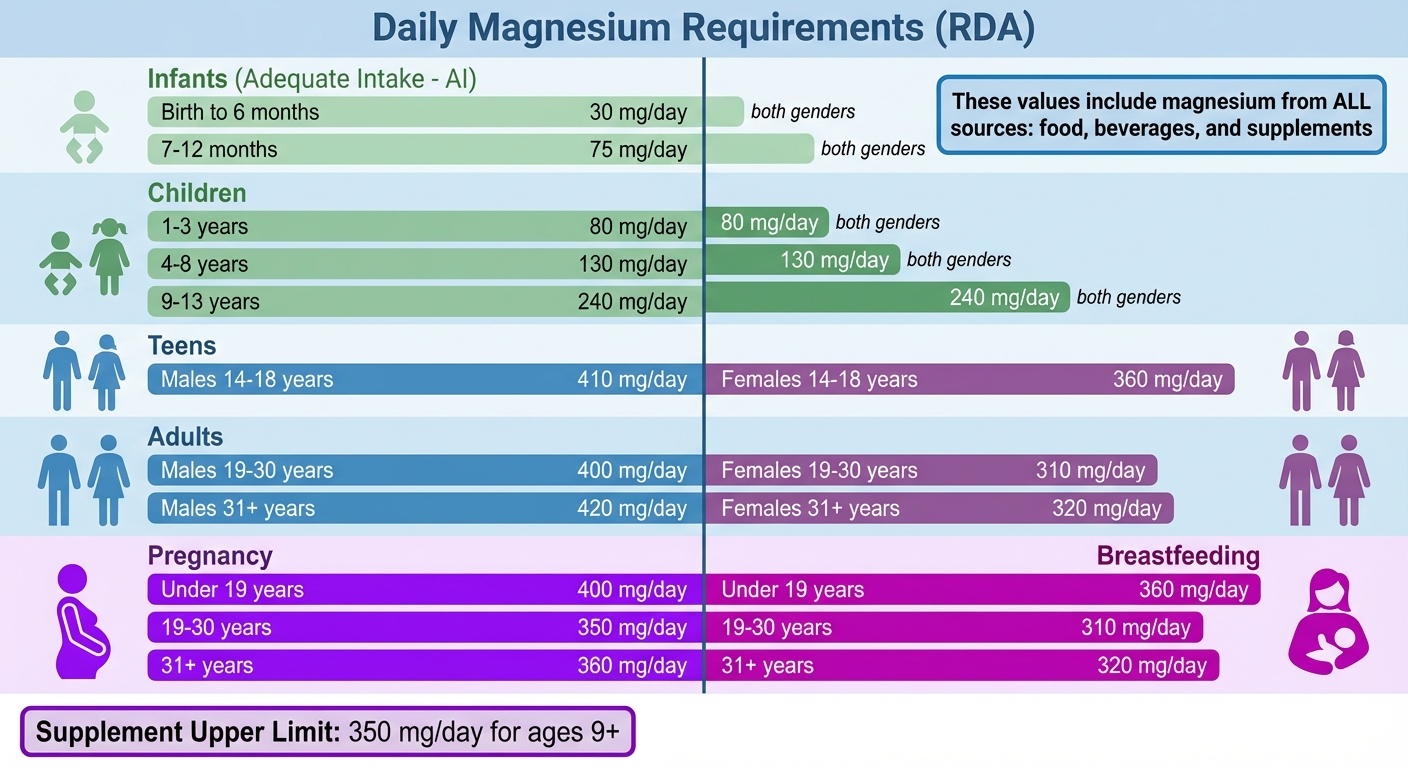
Daily Magnesium Requirements by Age, Gender, and Life Stage
The National Institutes of Health (NIH) provides Recommended Dietary Allowances (RDA) that aim to meet the magnesium needs of 97–98% of healthy individuals in the United States. These values cover magnesium intake from all sources - food, beverages, and supplements.
Magnesium requirements shift as we age. While boys and girls share the same needs during childhood, their requirements diverge during adolescence. Adult men generally require more magnesium than women due to their larger body size and greater muscle mass. Additionally, pregnant and breastfeeding women need higher amounts to support their baby's growth and milk production. Below, you'll find a detailed breakdown of the RDAs by life stage to help guide your daily intake.
RDA for Children and Teens
For infants, the NIH sets an Adequate Intake (AI) level rather than an RDA. Babies from birth to 6 months need 30 mg per day, and those aged 7–12 months require 75 mg per day. Typically, full-term infants get enough magnesium from breast milk or formula, so additional supplementation is unnecessary.
As children grow, the RDA comes into play. Toddlers aged 1–3 years need 80 mg daily, while kids aged 4–8 years require 130 mg daily. By the time children reach their preteen years (9–13 years), their magnesium needs increase to 240 mg daily to support rapid bone development and energy demands.
In adolescence, magnesium requirements begin to differ by gender. Teen boys aged 14–18 years need 410 mg daily, while teen girls in the same age group require 360 mg daily. This difference reflects the greater muscle and bone development in boys during puberty, as magnesium is essential for over 300 enzymatic processes, including those involved in growth and energy production.
RDA for Adults
For adult men aged 19–30 years, the RDA is 400 mg per day, increasing slightly to 420 mg per day for men aged 31 years and older. Women in the 19–30 year age range need 310 mg daily, which rises to 320 mg daily after age 31. These differences stem from men’s generally larger body size, greater muscle mass, and higher energy needs, all of which demand more magnesium.
The NIH does not specify a higher RDA for individuals over 50. Instead, the RDAs for adults aged 31 and up - 420 mg for men and 320 mg for women - remain the same. However, older adults may find it harder to meet these levels due to lower food intake, reduced magnesium absorption, and medications that can interfere with magnesium levels. For men in particular, focusing on magnesium-rich foods like nuts, seeds, whole grains, and legumes can help close dietary gaps.
Pregnancy and Breastfeeding Requirements
Pregnancy increases magnesium needs to support fetal bone development, maternal tissue growth, and higher energy demands. Pregnant teens (14–18 years) need 400 mg daily, while pregnant women aged 19–30 years require 350 mg daily. For those aged 31–50 years, the requirement is 360 mg daily.
For breastfeeding women, magnesium needs are slightly lower than during pregnancy but still higher than for non-pregnant individuals. Lactating teens (14–18 years) need 360 mg daily, while lactating women aged 19–30 years require 310 mg daily. For those aged 31–50 years, the RDA is 320 mg daily. These values ensure that breastfeeding women can maintain their own magnesium levels while meeting the nutritional needs of their infants.
| Life Stage | Male (mg/day) | Female (mg/day) |
|---|---|---|
| Birth–6 months (AI) | 30 | 30 |
| 7–12 months (AI) | 75 | 75 |
| 1–3 years | 80 | 80 |
| 4–8 years | 130 | 130 |
| 9–13 years | 240 | 240 |
| 14–18 years | 410 | 360 |
| 19–30 years | 400 | 310 |
| 31+ years | 420 | 320 |
| Pregnancy <19 years | - | 400 |
| Pregnancy 19–30 years | - | 350 |
| Pregnancy 31+ years | - | 360 |
| Lactation <19 years | - | 360 |
| Lactation 19–30 years | - | 310 |
| Lactation 31+ years | - | 320 |
Understanding your life stage is key to evaluating your magnesium intake and determining whether you might need supplements. Each stage has unique requirements, so tailoring your diet accordingly can help you meet your nutritional needs effectively.
Upper Limits for Magnesium Supplements
Recommended Dietary Allowances (RDAs) tell you how much magnesium you need daily, but Upper Limits (ULs) define the highest supplemental dose considered safe. These ULs, established by the National Institutes of Health (NIH), are designed to protect nearly all healthy individuals from potential side effects. It's important to note that ULs apply only to magnesium from supplements, medications, laxatives, and antacids - not food. Why? Because the magnesium you get from food is absorbed much slower, making it easier for your body to regulate. Let’s dive into why supplements require stricter limits.
Why Upper Limits Apply Only to Supplements
Magnesium from food is absorbed gradually, allowing your kidneys to efficiently clear any excess. On the other hand, supplements deliver concentrated doses, which can overwhelm your body’s natural regulation. This is why magnesium from food doesn’t pose a toxicity risk in healthy individuals, and no upper limit is set for dietary sources. However, high doses from supplements can lead to unpleasant digestive issues like diarrhea, nausea, and cramping .
Upper Limits by Age
The NIH has established specific ULs for magnesium supplements based on age groups. For infants under 12 months, no UL exists because they typically get all the magnesium they need from breast milk or formula. For children and adults, the limits vary:
- 1–3 years: 65 mg per day
- 4–8 years: 110 mg per day
- 9 years and older: 350 mg per day (this includes teens, adults, seniors, and pregnant or breastfeeding women)
Here’s a quick reference table:
| Age Group | UL for Supplemental Magnesium (mg/day) |
|---|---|
| Birth to 12 months | Not established |
| 1–3 years | 65 mg |
| 4–8 years | 110 mg |
| 9–18 years | 350 mg |
| 19+ years (adults & seniors) | 350 mg |
| Pregnancy (all ages) | 350 mg |
| Breastfeeding (all ages) | 350 mg |
Exceeding these limits can lead to digestive discomfort, such as diarrhea and cramping . For those with kidney problems, excessive magnesium intake can be even more dangerous, potentially leading to toxicity. Symptoms of magnesium toxicity include low blood pressure, confusion, muscle weakness, irregular heartbeat, and even cardiac arrest.
For example, let’s say an adult takes a multivitamin with 100 mg of magnesium, a separate 250 mg magnesium supplement, and occasionally uses magnesium-based laxatives. This combination could easily push them beyond the 350 mg UL. To stay safe, tools like SlipsHQ can help you track your magnesium intake by scanning product barcodes. This way, you can monitor your total magnesium consumption, avoid exceeding your UL, and still meet your RDA through a balanced diet and carefully selected supplements.
What Affects Your Magnesium Dosage
Magnesium requirements aren't the same for everyone. Factors like your overall health, dietary habits, and medication use can influence how much magnesium you need and how well your body handles supplements. Understanding these elements can help you adjust your magnesium intake safely.
Health Conditions and Medications
Your kidney health plays a major role in magnesium regulation. Healthy kidneys efficiently remove excess magnesium. However, for individuals with chronic kidney disease or impaired kidney function, magnesium can build up even at normal doses. This accumulation, known as hypermagnesemia, can cause symptoms like low blood pressure, nausea, muscle weakness, and in severe cases, heart rhythm issues. If you have kidney problems, avoid over-the-counter magnesium supplements unless prescribed and monitored by a doctor.
Digestive conditions can also impact magnesium levels. Disorders like celiac disease, inflammatory bowel disease, or short bowel syndrome can hinder magnesium absorption and lead to increased losses through chronic diarrhea. These issues raise the risk of deficiency. In such cases, smaller doses of gentler magnesium forms, like magnesium glycinate, may improve absorption .
Medications can further complicate magnesium levels. For example, loop and thiazide diuretics increase magnesium loss, while long-term use of proton pump inhibitors (PPIs) reduces its absorption. Additionally, magnesium can interfere with the effectiveness of certain medications, such as antibiotics (like tetracyclines or fluoroquinolones), bisphosphonates, and levothyroxine. To minimize interactions, take magnesium supplements at least two hours apart from these medications . Always consult your healthcare provider before starting magnesium supplements if you're on any of these drugs.
Now, let’s look at how much magnesium you might already be getting from your diet.
Magnesium from Food
The Recommended Dietary Allowance (RDA) for magnesium in adults is 310–420 mg per day, which includes magnesium from both food and supplements . Before adding a supplement, consider the magnesium already present in your meals. For example, 1 ounce of almonds contains about 80 mg of magnesium, 1 ounce of cashews provides 78 mg, ½ cup of cooked spinach has 71 mg, and you’ll find roughly 50 mg in either ½ cup of black beans or 1 cup of cooked brown rice. If your diet regularly includes magnesium-rich foods like nuts, seeds, whole grains, leafy greens, and legumes, you might already be close to meeting your daily needs without supplementation .
To get a clearer picture, track your food intake for a few days to estimate how much magnesium you're consuming. Then, if needed, select a supplement that bridges the gap to meet the RDA without exceeding the 350 mg/day upper limit for magnesium from supplements . Tools like SlipsHQ can help you scan supplement labels, verify elemental magnesium content, and receive safety alerts to manage your intake effectively.
Signs of Magnesium Overdose
Getting magnesium from food is generally safe, but taking too much through supplements can lead to problems. These range from mild stomach issues to more serious health risks. Recognizing the signs early can help you adjust your intake and avoid complications.
Mild Side Effects
The most common early sign of too much magnesium from supplements is diarrhea. When your intake exceeds 350 mg/day, your kidneys might struggle to get rid of the extra magnesium fast enough. This can cause water to move into your intestines, leading to loose stools. You might also notice nausea or stomach cramps as your body reacts to the overload. Symptoms like these often show up when doses hit 385–525 mg/day, which is about 1.1 to 1.5 times the recommended upper limit.
For example, the UK's National Health Service points out that doses over 400 mg/day often cause diarrhea, while lower amounts are usually fine for healthy adults. Certain forms of magnesium, like magnesium citrate and magnesium hydroxide, are more likely to cause diarrhea because they pull water into the bowel. That’s why they’re effective as laxatives but risky if overused.
If you notice digestive issues after starting a magnesium supplement, try lowering your dose or stopping it altogether. These mild symptoms usually go away within a day or two. However, if doses continue to increase, the risks can grow into something more serious.
Serious Risks of Toxicity
Taking very high doses of magnesium can lead to severe health problems, especially for people with kidney issues. While rare, magnesium toxicity (also known as hypermagnesemia) can be dangerous, particularly at doses above 1,750 mg/day - more than five times the upper limit. When magnesium levels in your blood reach 4–7 mEq/L, symptoms like low blood pressure, irregular heart rhythms, muscle weakness, and breathing problems can occur. If levels go beyond 10 mEq/L, it can result in paralysis, respiratory failure, or even cardiac arrest.
The National Institutes of Health (NIH) has documented cases where older adults using magnesium-containing laxatives for long periods developed severe hypermagnesemia. In these cases, blood magnesium levels rose above 4–5 mEq/L, causing symptoms like low blood pressure, slow heart rate, and, in some instances, death. People with kidney problems are especially vulnerable, even at moderate doses of 350–500 mg/day, because their kidneys can’t clear the excess magnesium as effectively.
If you’re taking magnesium supplements or laxatives and experience symptoms like dizziness, fainting, slow or irregular heartbeat, extreme muscle weakness, trouble breathing, confusion, or severe drowsiness, seek medical help immediately. These could be signs of dangerous magnesium toxicity that needs urgent treatment.
| Dosage Over UL | Adult Dosage Example | Mild Symptoms | Serious Symptoms |
|---|---|---|---|
| 1.1–1.5× | 385–525 mg/day | Diarrhea, nausea | None typically seen |
| 2–3× | 700–1,050 mg/day | Stomach cramping, vomiting | Low blood pressure |
| >5× | >1,750 mg/day | Severe digestive issues | Irregular heartbeat, breathing problems |
Keeping track of your magnesium intake is key to staying safe. Tools like SlipsHQ can help by scanning supplement labels, checking the magnesium content, and flagging any risky ingredients or interactions in your routine.
How to Take Magnesium Supplements Safely
Taking magnesium supplements isn’t something you should do blindly. To use them effectively and safely, you need to figure out how much magnesium your body actually needs, choose the right type of supplement, and keep an eye on your total intake.
Calculate Your Magnesium Needs
Before picking up a supplement, it’s a good idea to evaluate how much magnesium you’re already getting from your diet. For 3–7 days, track the magnesium-rich foods you eat. Some great sources include pumpkin seeds (535 mg per 100g), chia seeds (335 mg per 100g), almonds (80 mg per ounce), spinach (78 mg per cup), and black beans (120 mg per cup). Using a nutrition app or the USDA database can help you calculate your daily intake.
Once you know your average intake, compare it to the recommended dietary allowance (RDA): 400–420 mg/day for adult men and 310–320 mg/day for adult women. If you’re consistently falling short - say, getting 80–90% or less of your RDA - and experiencing symptoms like fatigue or muscle cramps, supplementation could be beneficial. To figure out how much to take, subtract your dietary intake from your RDA. For example, if you’re a 30-year-old woman with an RDA of 310 mg/day but only consume 200 mg from food, your gap is 110 mg. That’s the amount you might consider supplementing.
However, it’s crucial to stay within safe limits. Adults should not exceed 350 mg/day from supplements alone.
Choose the Right Magnesium Form
Not all magnesium supplements are created equal. Different forms of magnesium serve different purposes:
- Magnesium citrate: Absorbs well (about 90%) and is a good general option, though it may have a mild laxative effect.
- Magnesium glycinate: Gentle on the stomach and well-absorbed, making it a good pick if you have digestive issues or need help with sleep and anxiety.
- Magnesium oxide: Poorly absorbed (around 4%) and more likely to cause diarrhea. It’s better suited for short-term constipation relief rather than addressing a deficiency.
When choosing a supplement, look at the elemental magnesium content - this is the actual magnesium your body can use, not the total weight of the compound. To improve absorption and minimize stomach upset, divide your dose into 2–3 smaller servings taken with meals. If you’re on medications like antibiotics or bisphosphonates, take magnesium at least two hours apart to avoid interactions.
Monitor Dosage and Safety with SlipsHQ
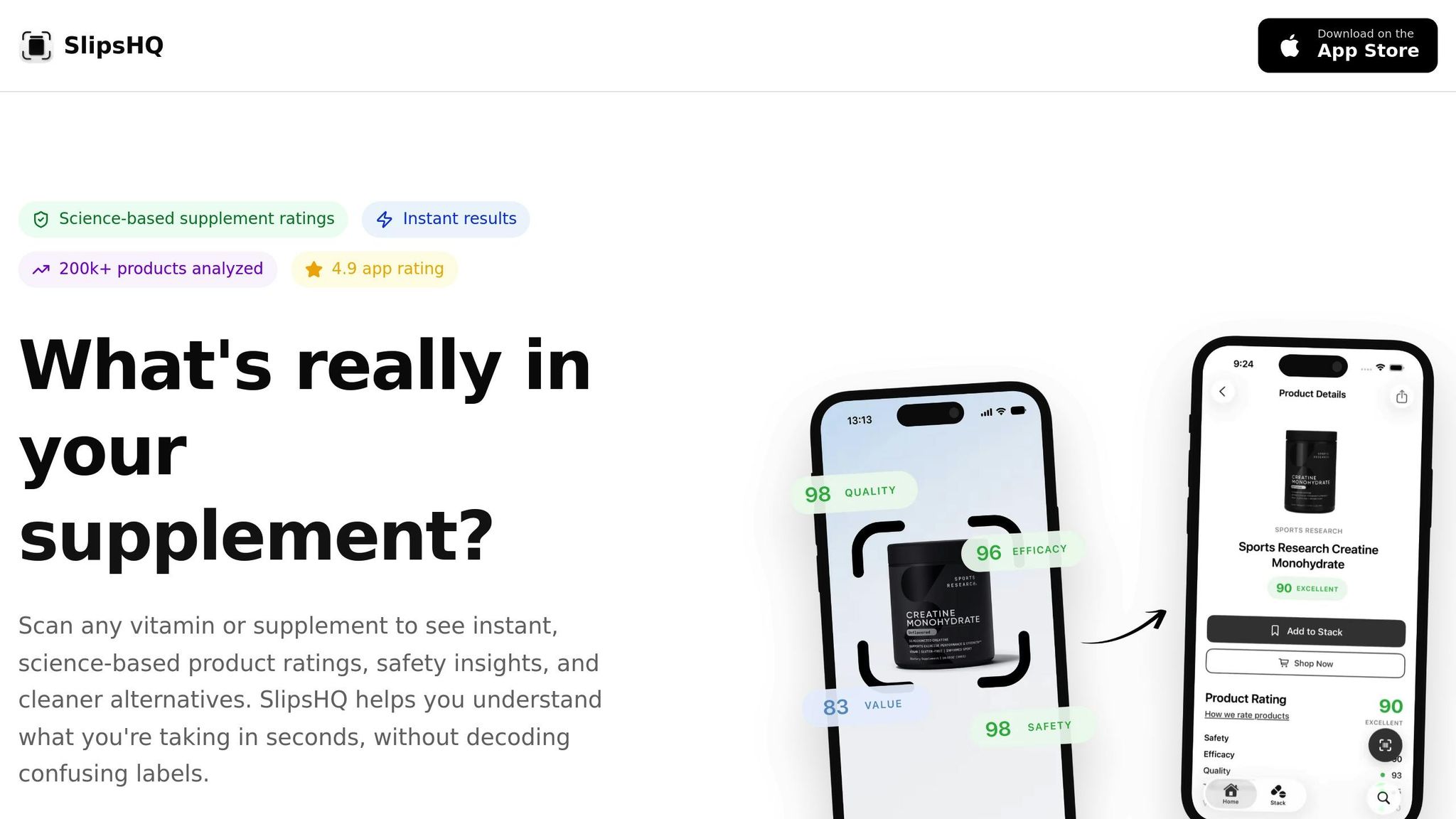
Managing magnesium intake from multiple supplements or products can get tricky. That’s where tools like SlipsHQ come in handy. This app lets you scan barcodes to check the elemental magnesium content, verify ingredient quality, and see safety ratings based on scientific data. It even alerts you if your supplemental magnesium approaches the 350 mg/day limit or if there’s a potential interaction with medications or other supplements in your routine.
SlipsHQ also helps you compare different magnesium forms and brands, view absorption rates, and create a personalized supplement plan that stays within safe limits. With a database of over 200,000 supplements, it’s a reliable tool to ensure you’re making smart, informed choices and avoiding excessive doses or risky ingredients.
Conclusion
Understanding your magnesium needs starts with knowing your Recommended Dietary Allowance (RDA) and the upper limit (UL) for supplements. For most U.S. adults, this means aiming for 310–420 mg/day, depending on factors like age and gender. Pregnant or breastfeeding individuals may need a bit more. When it comes to supplements, keep your intake at 350 mg/day or less if you're nine years or older. Luckily, magnesium from foods like leafy greens, nuts, seeds, and whole grains is naturally regulated by the kidneys, making it a safe option.
To put this into practice, evaluate your diet, health needs, and supplement choices. Start by estimating how much magnesium you’re already getting from food, compare that to your RDA, and only use supplements to fill the gap. If you have specific health concerns, such as kidney issues or are on medications that might interact with magnesium, consult your healthcare provider for guidance.
For a simpler way to manage your supplement intake, tools like SlipsHQ can be a game changer. This app scans supplement labels, checks the exact amount of elemental magnesium, and flags any risks. It even monitors your entire supplement routine, ensuring you don’t exceed the 350 mg/day limit or encounter potential drug interactions. With a database of over 200,000 supplements and personalized recommendations, SlipsHQ makes navigating the world of supplementation much easier.
Focus on whole foods first and use supplements only when necessary to meet your RDA, staying within safe limits unless advised otherwise by your doctor. If you're unsure about your current regimen, consider using reliable tools and consulting a healthcare professional to ensure you're on the right track. Accurate monitoring and informed decisions are key to maintaining safe magnesium levels.
FAQs
What’s the best way to safely add magnesium supplements to my diet?
To incorporate magnesium supplements into your diet safely, stick to the recommended daily allowance (RDA), which varies depending on factors like your age, gender, and overall health. Exceeding these limits can lead to unwanted side effects, so it’s crucial to stay within the safe range.
For guidance, tools like SlipsHQ can provide detailed safety ratings and ingredient breakdowns, helping you make better-informed choices about supplements. And don’t forget - always check in with a healthcare provider before starting any new supplement to ensure it aligns with your specific needs.
What are the symptoms of taking too much magnesium?
Taking an excessive amount of magnesium can result in unpleasant side effects such as diarrhea, nausea, and abdominal cramps. In more severe situations, it might lead to issues like an irregular heartbeat, low blood pressure, or even confusion.
If you think you’ve taken too much magnesium, reaching out to a healthcare provider right away is crucial to ensure any possible health concerns are properly managed.
Can health conditions or medications affect how your body absorbs magnesium?
Certain health conditions and medications can interfere with your body's ability to absorb magnesium, which might lead to deficiencies. For example, gastrointestinal issues like Crohn's disease or celiac disease can make it harder for your body to absorb magnesium effectively. Similarly, kidney problems can disrupt how your body manages magnesium levels.
Medications can also play a role. Diuretics, antibiotics, and proton pump inhibitors are known to either hinder magnesium absorption or increase how much your body excretes. If you're dealing with a medical condition or take medications regularly, it’s smart to check in with your healthcare provider. They can help ensure you're getting enough magnesium in a way that works for your specific needs.