
What Are Polymer-Based Delivery Systems?
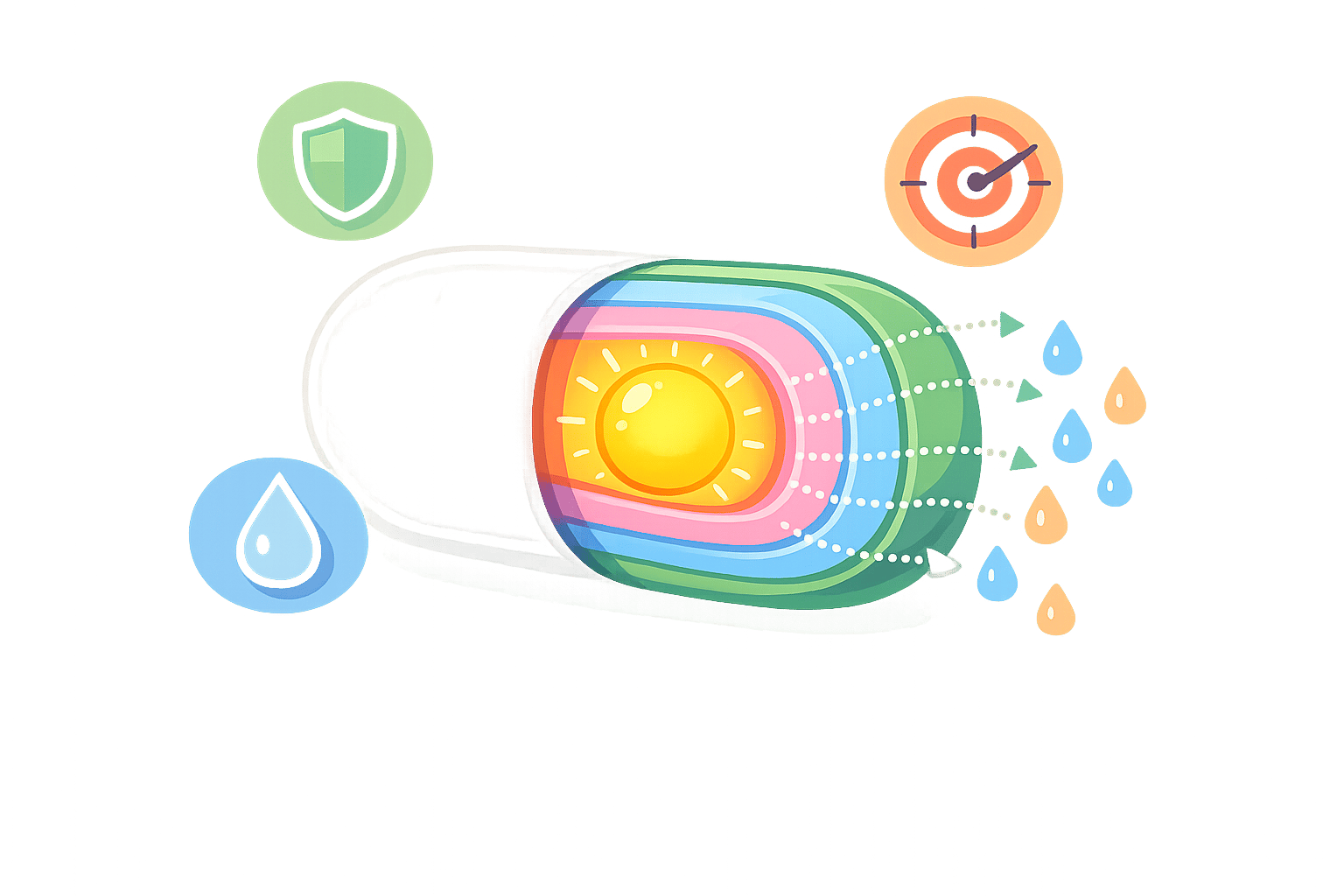
Polymer-based delivery systems use natural or synthetic polymers to protect and transport nutrients like vitamins and plant extracts through the body. These systems solve problems like poor absorption and nutrient breakdown during digestion, ensuring more effective delivery. For example:
- Curcumin: Encapsulation increases water solubility by 1.4 million times and boosts absorption 70-fold.
- Vitamin C: Liposomal systems enhance bioavailability by 1.77 times and extend shelf life from days to months.
Key Features:
- Encapsulation: Shields nutrients from heat, light, and stomach acid.
- Controlled Release: Delivers nutrients where and when they’re needed.
- Improved Solubility: Converts poorly soluble compounds into easily absorbed forms.
Types of Polymers:
- Biodegradable: Breaks down safely in the body (e.g., PLGA).
- Non-Biodegradable: Provides sustained release without degrading (e.g., ethyl cellulose).
- Natural: Biocompatible options like chitosan and alginate for targeted delivery.
While these systems improve absorption and stability, challenges include production consistency and potential safety concerns with polymer residues. Tools like SlipsHQ help evaluate supplement claims and safety.
How Polymer-Based Delivery Systems Work
Polymer-based delivery systems use a combination of strategies to safeguard nutrients, control their release, and improve absorption. These systems are carefully designed to adapt to the body's natural conditions, from the stomach's acidic environment to the more neutral or alkaline setting of the intestines. By working in harmony with these biological environments, they help ensure nutrients are delivered effectively.
Encapsulation and Protection
Polymers play a critical role in protecting sensitive compounds from external factors like light, oxygen, heat, and moisture before they are consumed. For example, enteric polymers such as alginate, chitosan, and Eudragit are engineered to remain intact in the stomach's acidic pH (~2), preventing early degradation. Some biopolymers, like resistant starch and pectin, are even resistant to digestive enzymes in the upper gastrointestinal tract. These compounds release their cargo only in the colon, where microbial enzymes break them down.
A great example of this is lignin-based complex micelles. In tests simulating gastric conditions (pH 1.2), they retained over 75% of their cargo (ibuprofen) and released more than 90% in simulated intestinal conditions (pH 7.4). This pH-sensitive behavior ensures nutrients or drugs survive the harsh stomach environment and are released exactly where they can be absorbed.
Once the compound is protected, polymers also manage the timing and location of its release.
Controlled and Targeted Release
Polymers don't just shield nutrients - they also regulate when and where they are released. Diffusion-controlled systems, for instance, allow nutrients to move from areas of high concentration to low concentration steadily over time. Swelling-activated hydrogels take a different approach. These materials absorb water, softening and creating pathways for nutrients to be released.
Some polymers are even tailored to respond to specific triggers in the body. For example, pH-sensitive polymers release their cargo in response to changes in acidity. Others respond to temperature shifts or redox conditions, like high glutathione levels, to deliver nutrients precisely where they are needed. Mucoadhesive polymers, such as chitosan, can stick to the intestinal lining, increasing the time they stay in the gut and improving absorption.
Better Solubility and Stability
One of the biggest challenges in nutrient delivery is poor water solubility, which can limit how well nutrients are absorbed. Polymers tackle this problem using several clever techniques. Amorphous Solid Dispersions (ASDs) are one solution, converting crystalline compounds into an amorphous form that dissolves more easily. The polymer in these systems acts as a stabilizer, preventing the compound from recrystallizing during storage or digestion.
Another approach involves amphiphilic polymers, which form micelles. These micelles have a hydrophobic core that traps poorly soluble compounds and a hydrophilic shell that helps them disperse in the gut. By reducing particle size to the nanoscale (1–100 nanometers), these systems dramatically increase the surface area available for dissolution, speeding up absorption.
Recent research highlights the potential of these technologies. In February 2024, scientists at the University of Central Punjab developed a Self-Nanoemulsifying Drug Delivery System (SNEDDS) for Ticagrelor. This formulation, which included clove oil (10–20%), Tween-80 (45–70%), and PEG-400 (20–45%), improved drug dissolution at pH 6.8 from 28.05% to an impressive 98.45%. Similarly, a November 2023 study demonstrated that Rutin nanocrystals stabilized with HP-β-CD increased aqueous solubility by 202 times and improved photostability by 2.3 times.
Types of Polymers Used in Delivery Systems
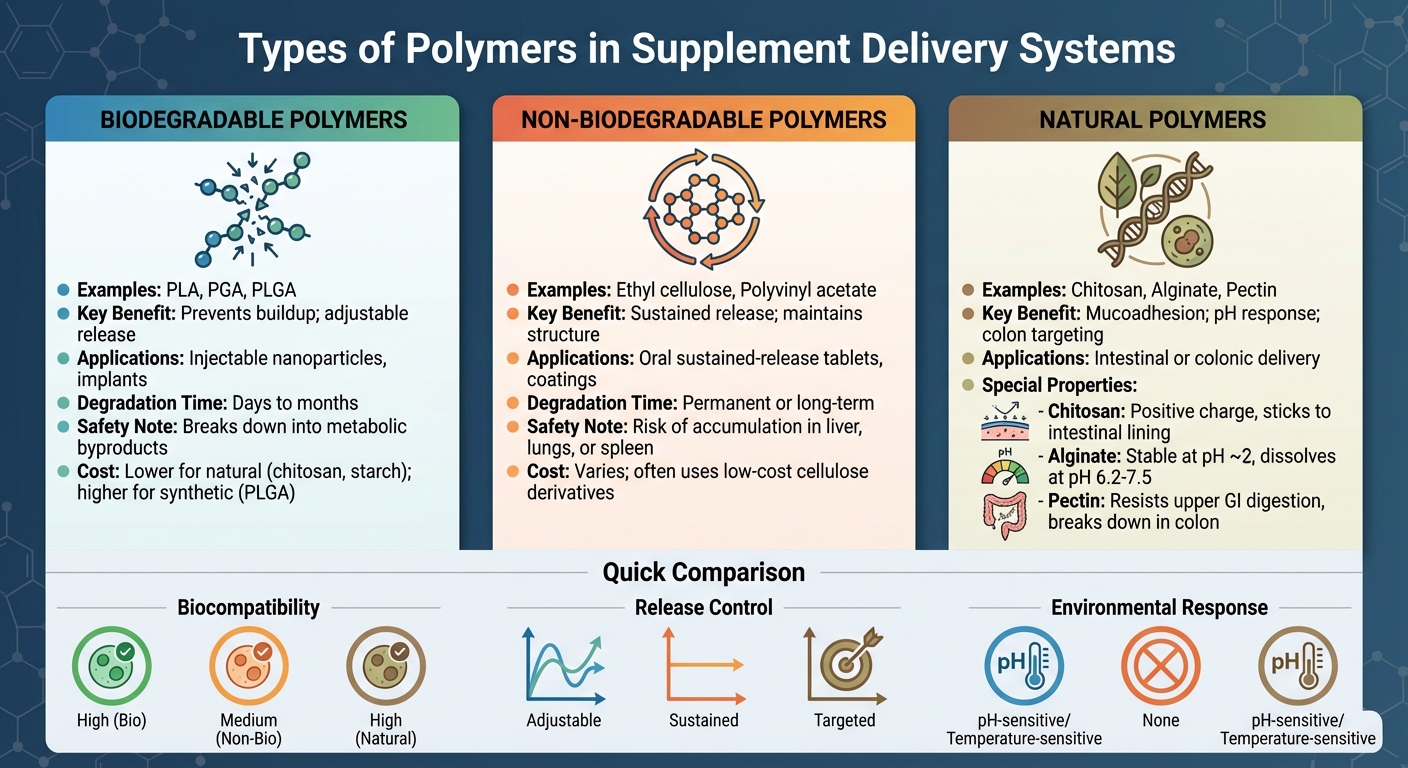
Biodegradable vs Non-Biodegradable Polymers in Supplement Delivery Systems
The type of polymer used in supplement delivery systems plays a key role in determining how the supplement is released, how long it stays effective, and how safe it is for the body. Let’s break down the main categories of polymers and why they’re used in specific formulations.
Biodegradable Polymers
Biodegradable polymers are designed to break down in the body through processes like hydrolysis or proteolysis. Some common examples include polylactic acid (PLA), polyglycolic acid (PGA), and poly(lactide-co-glycolide) (PLGA). These polymers degrade by breaking their ester bonds, turning into small, non-toxic compounds that the body can naturally eliminate.
"The majority of biodegradable synthetic polymers rely on hydrolytic cleavage of ester bonds or ester derivatives such as poly(lactic/glycolic acid) and poly(ε-caprolactone)." - William B Liechty, Department of Chemical Engineering, University of Texas
PLGA is particularly noteworthy because of its strong safety record and its ability to be modified for targeted delivery, such as attaching antibodies. These features make it ideal for long-term delivery systems like injectable nanoparticles or implants. Additionally, manufacturers can fine-tune the release rate by altering the polymer's molecular weight or composition.
Unlike biodegradable polymers, non-biodegradable options release their contents without breaking down.
Non-Biodegradable Polymers
Non-biodegradable polymers retain their structure while releasing their contents through diffusion or surface erosion. Popular choices include ethyl cellulose and polyvinyl acetate, both of which are widely used in sustained-release formulations.
These polymers are especially effective for oral supplements that need a slow, steady release over several hours. For instance, ethyl cellulose is often applied as a tablet coating to protect moisture-sensitive ingredients while allowing gradual release through its water-insoluble matrix. Since these polymers don’t degrade, they offer consistent release rates and excellent protection for fragile compounds.
Natural polymers, on the other hand, bring their own set of advantages, particularly in biocompatibility.
Natural Polymers
Natural polymers are valued for their compatibility with the body and their unique biological properties. Common examples include chitosan, alginate, and pectin.
- Chitosan has a positive charge, which helps it stick to the intestinal lining. This mucoadhesive property increases the time supplements stay in the gut, improving absorption of poorly soluble nutrients.
- Alginate reacts to pH changes, staying stable in the acidic stomach (pH ~2) but dissolving in the more alkaline small intestine (pH 6.2–7.5). This makes it ideal for protecting acid-sensitive ingredients like probiotics or certain vitamins.
- Pectin and resistant starch resist digestion in the upper gastrointestinal tract but are broken down by microbes in the colon, making them perfect for delivering nutrients to the colon.
| Category | Examples | Benefit | Use |
|---|---|---|---|
| Biodegradable | PLA, PGA, PLGA | Prevents buildup; adjustable release | Injectable nanoparticles, implants |
| Non-Biodegradable | Ethyl cellulose, Polyvinyl acetate | Sustained release; maintains structure | Oral sustained-release tablets, coatings |
| Natural | Chitosan, Alginate, Pectin | Mucoadhesion; pH response; colon targeting | Intestinal or colonic delivery |
Each polymer type brings specific benefits, allowing manufacturers to create systems that maximize nutrient absorption and match the needs of different supplements.
Applications in Common Supplements
Polymer-based systems are transforming how supplements are formulated, tackling challenges like poor absorption and instability, and ultimately improving their effectiveness.
Curcumin and Resveratrol
Both curcumin and resveratrol face significant hurdles when it comes to absorption. For instance, curcumin has a water solubility of just 11 micrograms per milliliter and an oral bioavailability of around 1%. Resveratrol isn’t much better, with an aqueous solubility of only 3 milligrams per liter, leading to similarly low absorption rates.
Polymer-based delivery systems provide innovative solutions to these issues. Cyclodextrins, for example, feature a structure with a hydrophobic interior and hydrophilic exterior, allowing them to form inclusion complexes with curcumin. This approach dramatically improves curcumin's solubility. Specifically, hydroxypropyl beta-cyclodextrin (HP-β-CD) has been shown to increase curcumin's oral bioavailability by 2.77 times. These systems give manufacturers versatile ways to optimize curcumin formulations.
Another approach involves pH-sensitive polymers like Eudragit S100. These polymers remain stable in the acidic environment of the stomach (pH below 7.0) but dissolve in the upper intestine, protecting sensitive compounds from degradation and ensuring they reach the small intestine intact. Meanwhile, poly(β-amino ester) hydrogels chemically bond curcumin to the polymer matrix, enabling controlled release over 16 to 26 hours and reducing the risk of "dose dumping".
These advancements pave the way for more effective nutrient delivery systems.
Vitamins and Minerals
When it comes to vitamins and minerals, polymer systems address common challenges like instability and poor absorption. Take Vitamin C, for example - it oxidizes quickly when exposed to air, light, or metal ions. Liposomal delivery systems not only stabilize Vitamin C but also enhance its absorption.
Fat-soluble vitamins such as A, D, E, and K pose another challenge in water-based formulations. Nanoemulsions and liposomes solve this by dispersing these vitamins in aqueous solutions without compromising their potency. Additionally, polymer coatings like Eudragit L and S help ensure targeted release, minimizing premature breakdown in the upper gastrointestinal tract and delivering nutrients to the optimal absorption sites. Mucoadhesive polymers such as chitosan further improve absorption by adhering to the intestinal lining and extending the time vitamins remain in contact with absorption sites.
| Delivery System | Ingredient | Improvement | Key Benefit |
|---|---|---|---|
| Liposomes | Vitamin C | 1.77x bioavailability | Extends shelf life from days to 2 months |
| HP-β-CD | Curcumin | 2.77x bioavailability | Enhances solubility and absorption |
| PBAE Hydrogel | Curcumin | Sustained release (16–26 hours) | Prevents dose dumping |
| Nanostructured Lipid Carriers | Quercetin | 12x bioaccessibility (from 5% to 60%) | Higher loading capacity |
These cutting-edge delivery systems are making it possible to overcome traditional barriers in supplement formulation, ensuring nutrients are not only stable but also efficiently absorbed.
Advantages and Limitations
Polymer-based delivery systems bring a new level of efficiency to supplement performance, but they also come with challenges that both manufacturers and consumers need to consider.
One of the key advantages is their ability to improve bioavailability, enhancing how well compounds dissolve without altering their structure. These systems are particularly effective at protecting delicate nutrients like Vitamin C and polyphenols from damage caused by light, heat, oxidation, or stomach acid. Some biopolymers, such as chitosan, even offer mucoadhesion, meaning they can stick to the intestinal lining, allowing nutrients to be absorbed over a longer period.
However, these systems aren't without their limitations. A significant concern involves the safety of biodegradable polymer breakdown products. William B. Liechty from the University of Texas Department of Chemical Engineering explains:
"A well-known issue with biodegradable polymers is uncertainty with regard to the safety of degradation products. Because degradation often results in a distribution of fragment sizes, toxicity is challenging to determine experimentally".
Non-biodegradable polymers pose their own risks, as they can accumulate in organs like the liver, lungs, or spleen if the body cannot naturally eliminate them.
On the production side, maintaining consistency in particle size, surface charge, and nutrient loading during industrial-scale manufacturing is a major challenge. Another issue is the "burst release" effect, where too much of the active ingredient is released too quickly, potentially leading to unsafe concentrations. The lack of standardized international methods for characterizing nanoparticles in supplements only adds to the regulatory hurdles.
Comparison: Biodegradable vs. Non-Biodegradable Polymers
The table below highlights the main differences between biodegradable and non-biodegradable polymers:
| Feature | Biodegradable Polymers | Non-Biodegradable Polymers |
|---|---|---|
| Bioavailability Improvement | High; supports uptake through endocytosis and lymphatic transport | Moderate to High; focuses on solubility and stability |
| Degradation Time | Days to months; breaks down into metabolic byproducts | Permanent or long-term; relies on natural clearance |
| Cost | Lower for natural polymers (e.g., chitosan, starch); higher for synthetic ones like PLGA | Varies; often uses low-cost materials like cellulose derivatives |
| Common Applications | Targeted intestinal release, short-term use | Long-term systems like transdermal patches |
| Safety Concerns | Potential toxicity from degradation fragments | Risk of accumulation in tissues, leading to chronic inflammation |
Using SlipsHQ to Evaluate Polymer-Based Supplements
Polymers play a key role in enhancing nutrient delivery, but assessing their safety and effectiveness in supplements can be tricky. That’s where SlipsHQ steps in, simplifying the evaluation process. This tool scans ingredient lists for polymer matrices like HPMC, PEG, and chitosan - commonly found in Amorphous Solid Dispersions that improve the solubility of nutrients with low water solubility.
The app goes further by identifying "smart" polymers, such as pH-responsive hydrogels like P(MAA-g-EG), which release nutrients specifically in the small intestine. It can even differentiate between various generations of lipid-based systems. For example, it recognizes Nanostructured Lipid Carriers (NLCs), which offer better nutrient loading and stability compared to earlier lipid-based systems.
Safety is a top priority. SlipsHQ flags potential concerns with biodegradable polymers that may release fragments with unknown toxicity, as well as non-biodegradable ones that could accumulate in organs like the liver or spleen. This is particularly relevant given that over 20 approved products currently use cellulose-based polymers as stabilizers. The app provides transparency, helping consumers understand exactly what they’re ingesting.
SlipsHQ also evaluates bioavailability improvements in advanced systems like nanospheres, micelles, and nanosponges. For instance, studies show that polymeric nanosponges can enhance the oral bioavailability of certain phytonutrients by 2.5 to 3.2 times. With this tool, you can verify whether a supplement delivers on such promises - or if its claims are exaggerated.
Conclusion
Polymer-based delivery systems have transformed how supplements deliver nutrients, tackling a long-standing issue: many nutrients either break down in the digestive process or fail to absorb efficiently. Encasing nutrients in polymer shells can significantly improve absorption rates - for example, curcumin absorption can increase by 70 times, and Vitamin C by 1.77 times.
The type of polymer used plays a crucial role in both safety and effectiveness. Biodegradable polymers like chitosan and PLGA break down into harmless byproducts, making them a safer choice. On the other hand, non-biodegradable polymers may pose risks due to potential accumulation in the body. Additionally, natural polymers appeal to those looking for "clean-label" supplements, while synthetic polymers offer precise control over nutrient release.
Advanced systems, such as pH-responsive hydrogels, take this technology a step further. These smart systems protect nutrients from stomach acid and ensure they are released in the small intestine, where absorption is most effective.
For those trying to make sense of these innovations, SlipsHQ simplifies the process. The app evaluates polymer-based supplements, highlights any safety concerns, and verifies bioavailability claims with scientific backing. If a product boasts enhanced absorption through nanoencapsulation or controlled-release polymers, SlipsHQ helps you determine if those claims are credible.
FAQs
What are polymer-based delivery systems, and how do they enhance nutrient absorption?
Polymer-based delivery systems are cutting-edge solutions designed to optimize how the body absorbs nutrients or supplements. These systems enhance absorption by controlling the release of nutrients, targeting specific areas in the body, and improving bioavailability. To achieve this, they rely on advanced materials like hydrogels, nanoparticles, and nanomicelles, which help deliver nutrients with precision and efficiency.
Techniques such as encapsulation, sustained release, and mucoadhesion play a key role in these systems. They protect delicate ingredients and ensure nutrients are absorbed exactly where they’re needed. This makes supplements more effective, offering a dependable way to support your health and wellness goals.
What are the potential safety concerns with biodegradable and non-biodegradable polymers?
Biodegradable and non-biodegradable polymers each bring their own set of challenges when it comes to safety.
Biodegradable polymers often struggle with stability under physiological conditions, which can limit their reliability in controlled delivery systems. On top of that, scaling up their production while ensuring consistent quality can be a tricky process.
Non-biodegradable polymers, however, come with an entirely different problem: environmental impact. These materials can persist in nature, contributing to the growing issue of microplastic pollution. Over time, this buildup can harm ecosystems and potentially affect human health.
Addressing these issues is key to assessing the safety and long-term impact of polymer-based delivery systems.
How do natural polymers like chitosan and alginate improve supplement absorption?
Natural polymers such as chitosan and alginate are important for improving how well supplements are absorbed by the body. They work by creating a protective barrier around active ingredients, shielding them from the stomach's harsh environment. This ensures that nutrients remain intact and can reach the areas of the body where they’re needed most.
These polymers also help regulate how supplements are released, leading to a slower, more controlled absorption process. This method boosts the bioavailability of nutrients, making it easier for your body to get the maximum benefit from the supplements you take.