
What Third-Party Testing Means for Supplements
When you buy supplements, you trust the label to be accurate. But here's the reality: the FDA doesn’t test or approve supplements before they hit the shelves. This means manufacturers are responsible for quality and safety, often without proof upfront. That’s where third-party testing comes in.
Third-party testing is done by independent labs to verify a supplement’s ingredients, potency, and purity. These labs ensure the product matches its label, is free from harmful contaminants like heavy metals or pesticides, and meets safety standards. Certification seals like USP Verified, NSF Certified for Sport, and Informed Choice help you identify reliable products.
Key Takeaways:
- What it checks: Ingredients, dosage accuracy, and contaminants.
- How it works: Independent labs test products using advanced methods like chromatography and mass spectrometry.
- Why it matters: Supplements often skip FDA pre-approval, so third-party testing adds an extra layer of safety.
- How to find tested products: Look for certification seals, check manufacturer transparency, and use tools like the SlipsHQ app for verification.
For safer choices, stick to supplements with certification seals and brands that openly share testing results.
What Is Third-Party Testing?
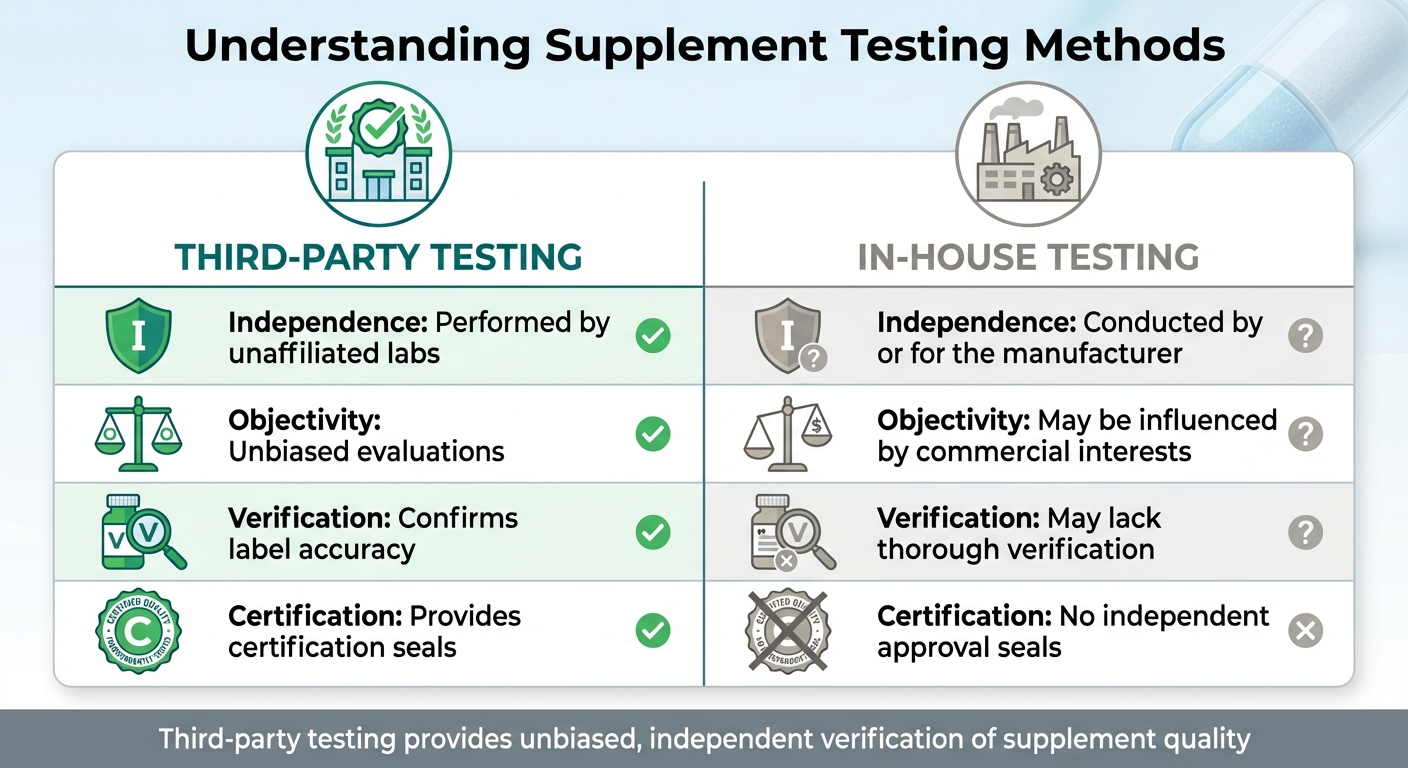
Third-Party vs In-House Supplement Testing Comparison
Third-party testing involves independent labs assessing the quality, safety, and accuracy of a supplement. Unlike in-house testing - where manufacturers might have a vested interest that could sway results - third-party labs provide an unbiased review. This process ensures that the ingredients listed on the product label are present and that the supplement meets its stated claims. This added level of scrutiny helps build trust in the product's authenticity.
"Independent and unbiased. SlipsHQ does not sell supplements, accept paid placements, or boost scores for brands. Our ratings are based on observable data, certifications, testing practices, and ingredient standards - not sponsorships." – SlipsHQ
How Third-Party Testing Works
For third-party testing, manufacturers send finished supplements to accredited, independent labs. These labs use advanced scientific methods to verify that the product's contents align with its label. They check for the presence of each ingredient, measure the potency of active components, and screen for contaminants like heavy metals, pesticides, or undeclared substances.
Techniques such as high-performance liquid chromatography (HPLC), mass spectrometry, and gas chromatography allow for precise analysis. If the product meets the required standards, it may earn a certification seal, signaling its quality and accuracy.
Some programs take this process a step further by purchasing supplements directly from store shelves instead of relying solely on samples provided by manufacturers. This ensures the tested batch accurately reflects what consumers are actually buying. Additionally, many certification programs require ongoing batch testing and periodic facility inspections to maintain consistent quality over time. These thorough measures highlight the importance of independent testing when choosing a supplement.
Third-Party Testing vs. In-House Testing
The key difference between third-party and in-house testing lies in objectivity. In-house testing is conducted by manufacturers themselves, giving them control over the methods and interpretation of results - potentially introducing bias. On the other hand, independent labs follow strict, standardized protocols and are accredited by organizations like ISO. Since these labs have no financial ties to the product, their findings are impartial and reliable.
For example, NSF International conducts testing in its own accredited labs rather than relying on data submitted by manufacturers.
| Aspect | Third-Party Testing | In-House Testing |
|---|---|---|
| Independence | Performed by unaffiliated labs | Conducted by or for the manufacturer |
| Objectivity | Unbiased evaluations | May be influenced by commercial interests |
| Verification | Confirms label accuracy | May lack thorough verification |
| Certification | Provides certification seals | No independent approval seals |
This level of impartiality is crucial, as consumers need confidence that the supplement's label truly reflects its contents.
Why Third-Party Testing Matters
Third-party testing plays a crucial role in ensuring the quality of dietary supplements by independently verifying their ingredients and checking for contaminants. In an industry with limited FDA oversight before products hit the market, this extra layer of scrutiny is essential. Unlike pharmaceuticals, which are tightly regulated, supplements are treated more like foods, leaving manufacturers responsible for their own product safety and labeling accuracy. The FDA typically steps in only when safety issues or complaints arise. Independent testing not only reinforces trust in product claims but also helps protect consumers from harmful substances.
Safety and Contaminant Detection
Independent labs conduct thorough screenings to detect heavy metals like lead, arsenic, cadmium, and mercury, as well as pesticide residues, microbial contaminants (such as bacteria, mold, and yeast), and undeclared pharmaceuticals or stimulants. These evaluations are essential for catching potential hazards before products reach store shelves.
Investigations have uncovered supplements contaminated with banned substances, unlisted drugs, and dangerously high levels of heavy metals - issues especially prevalent in weight loss, bodybuilding, and sexual enhancement products. Programs like NSF Certified for Sport and Informed Choice were established partly to address situations where athletes unknowingly tested positive for banned substances due to contaminated supplements. By identifying these risks, third-party testing helps prevent both immediate health issues, such as allergic reactions or toxic exposures, and long-term problems caused by repeated exposure to contaminants. Beyond safety, these tests also ensure that what’s listed on the label matches what’s in the product.
Product Accuracy and Label Claims
Third-party testing also verifies the accuracy of a product’s label through identity and potency checks. These tests confirm that supplements contain authentic ingredients in the amounts stated, addressing concerns about both safety and effectiveness. Identity testing ensures that each ingredient is genuine. Potency testing measures the dosage of active ingredients to confirm they meet label claims, guarding against underdosing (which reduces effectiveness) or overdosing (which increases potential side effects or toxicity).
When potency is inaccurate, it can lead to ineffective results or unintended excessive intake. This is particularly problematic for individuals working with healthcare providers, as clinicians rely on accurate label information to assess potential interactions, side effects, and overall daily intake across multiple supplements.
Closing Regulatory Gaps
Since the FDA’s pre-market oversight is limited, ongoing third-party evaluations act as a critical quality control measure. Under current U.S. law, the FDA can inspect manufacturing facilities and address issues with adulterated or mislabeled products, but it does not pre-approve supplement formulas or routinely test them before they are sold. Third-party testing steps in to bridge this gap by auditing manufacturing practices and performing regular product testing.
Programs such as USP Verified, NSF (including NSF Certified for Sport), Informed Choice/Informed Sport, ConsumerLab, and others are essential in this process. These initiatives combine facility audits with rigorous testing of finished products to verify label claims, check for contaminants, and assess formulations for toxicological concerns. Many of these programs also require periodic batch testing, ensuring consistent quality as production batches change.
What Third-Party Labs Test For
Third-party labs play a crucial role in evaluating supplements. Using advanced analytical and microbiological methods, they assess products across several key areas to ensure quality, safety, and accuracy.
Active Ingredient Verification
When it comes to active ingredients, precision is non-negotiable. Labs use detailed chemical analyses to confirm that supplements contain the ingredients listed on their labels - and in the correct amounts. For example, identity testing ensures that what’s labeled as curcumin isn’t just turmeric powder mixed with fillers. Potency testing takes it a step further by measuring the exact dose of each active ingredient to match the label claims.
To illustrate, if a supplement claims to have 500 mg of an ingredient, labs verify that this amount is accurate. They test samples from multiple production batches to ensure consistency, then issue a Certificate of Analysis (COA) for each batch. This COA documents the product’s identity, purity, quality, strength, and composition. Accurate ingredient verification sets the stage for the next step: contaminant testing.
Contaminant Testing
Contaminant testing is all about identifying substances that shouldn’t be in your supplements. Labs screen for heavy metals like lead, arsenic, cadmium, and mercury, as well as pesticides and microbial contaminants such as bacteria, yeast, and mold. They also check for undeclared ingredients that may show up during testing.
For athletes, additional certifications like NSF Certified for Sport® and Informed Choice provide extra peace of mind. NSF Certified for Sport® screens for around 290 banned substances, ensuring compliance with major sports organizations. Similarly, Informed Choice tests for over 250 substances, including drugs of abuse, anabolic agents, SARMs, stimulants, hormone modulators, and narcotics. Each certified batch undergoes testing in an ISO/IEC 17025–accredited anti-doping lab.
Other Quality Tests
Beyond ingredients and contaminants, labs conduct additional tests to ensure the overall reliability of supplements. Dissolution and disintegration tests confirm that tablets and capsules break down properly in the body, allowing active ingredients to be absorbed effectively. Stability testing ensures that the product maintains its quality throughout its shelf life.
Safety reviews are another important step. Toxicology assessments evaluate formulations for potential risks. For supplements with specific claims like "gluten-free", labs use techniques like ELISA to verify the absence of allergens. Certification programs also perform regular batch testing and facility audits to ensure that standards are consistently met over time, rather than relying on a one-time check.
How to Find Third-Party Tested Supplements
Look for Certification Seals
When shopping for supplements, start by checking the packaging for certification seals. Trusted third-party certifications include USP Verified, NSF (including NSF Certified for Sport®), Informed-Choice/Informed-Sport, ConsumerLab, and BSCG Certified Drug Free. These logos are usually displayed prominently on the front label near the product name but can sometimes be found on a side panel. Take a moment to inspect the packaging carefully.
Each seal signifies that the product meets specific testing standards and manufacturing guidelines. To ensure the certification is genuine, visit the certifier's website and search for the product, brand, or lot number.
Investigate Manufacturer Transparency
Reliable supplement brands are upfront about their testing processes. Visit the manufacturer's website and look for a section dedicated to quality or testing practices. This page should outline their third-party testing partners and the types of tests performed, such as identity verification, potency checks, and screenings for contaminants like heavy metals, microbes, and pesticides. Many companies also make Certificates of Analysis (COAs) available for download. These COAs often include details about the lab's accreditation and the results of specific tests.
If the label or website doesn’t provide clear information about testing, reach out to the company directly. Ask specific questions like:
- "Does an independent third-party lab test your products? If so, which lab?"
- "Are all batches tested, or is testing done periodically?"
- "Can you share the most recent Certificate of Analysis for the lot on my bottle?"
Avoid products from brands that cannot provide verifiable documentation or clear answers. Transparency is key when it comes to supplement safety and quality.
Leverage Verification Tools
Digital tools can make the process of verifying supplement quality even easier. For example, the SlipsHQ mobile app lets you scan a product's barcode to access trust scores, ingredient analyses, and information about recognized third-party certifications. By pulling data from public databases and research, the app can highlight missing certifications or questionable additives. With over 200,000 supplements analyzed, it’s a helpful resource for building a personalized supplement routine that prioritizes purity, potency, and thorough contaminant testing.
Additionally, organizations like NSF, USP, and Informed-Choice offer searchable online databases. These tools allow you to confirm a product’s certification status by entering its name, brand, or lot number. Since the FDA does not pre-approve supplements before they hit the market, using these independent resources provides an extra layer of assurance about label accuracy and contaminant testing standards.
Conclusion
Because dietary supplements bypass FDA approval, third-party testing plays a crucial role in verifying label accuracy and checking for contaminants. This independent evaluation ensures both safety and consistent product quality by confirming ingredients and potency while screening for harmful substances.
Opting for supplements with trusted third-party certification seals - like USP Verified, NSF, Informed Choice, or BSCG - can give you peace of mind. Whether you're an athlete avoiding accidental exposure to banned stimulants, someone pregnant looking for a prenatal vitamin with verified folate levels, or an older adult managing multiple medications and searching for reliable omega-3 fish oil, these certifications guide you toward safer, more reliable choices. They help bridge the gap between bold marketing claims and real consumer safety.
You don’t need to be an expert to make informed decisions. Look for certification seals, check certifiers' databases for details, and choose brands that openly share test results and manufacturing processes. Tools like the SlipsHQ app make this even easier. By scanning a barcode, you can instantly access trust scores, ingredient purity data, and third-party certification status for over 200,000 supplements. This makes comparing products and building a routine based on clear, science-backed insights more straightforward than ever.
The supplement aisle can feel overwhelming, but focusing on third-party-tested products and using simple verification strategies can lead to safer, better-informed choices. While independent testing complements professional medical advice, it’s a valuable starting point for navigating the complexities of an imperfect regulatory system.
FAQs
Why does third-party testing matter for supplement safety?
Third-party testing plays a key role in confirming that supplements are safe, effective, and correctly labeled. Independent labs carry out these tests to verify the quality and purity of ingredients while also screening for harmful contaminants like heavy metals or hidden additives.
This rigorous process ensures consumers can trust that the products they’re using meet strict safety standards. Tools such as SlipsHQ simplify this process by analyzing supplements for their quality, safety, and effectiveness, empowering you to make well-informed choices about your health.
How can I tell if a supplement has been third-party tested?
If you want to check whether a supplement has been tested by a third party, tools like barcode scanners can be incredibly helpful. Take SlipsHQ, for instance - it simplifies the process by offering science-backed ratings, details on ingredient purity, and important safety alerts. This way, you can make informed decisions, knowing the supplements you choose are supported by clear and trustworthy information about their quality and safety.
What’s the difference between third-party and in-house testing for supplements?
Third-party testing involves independent laboratories evaluating supplements to confirm their safety, quality, and ingredient accuracy. Since these labs work independently of the manufacturer, their findings are impartial and reliable.
On the other hand, in-house testing is carried out by the supplement manufacturer. While it can yield valuable insights, it doesn't always match the objectivity and consistency of third-party evaluations. For consumers, choosing supplements with third-party testing ensures a higher level of trust and clarity, which is essential when prioritizing quality.