
Understanding Supplement Labels
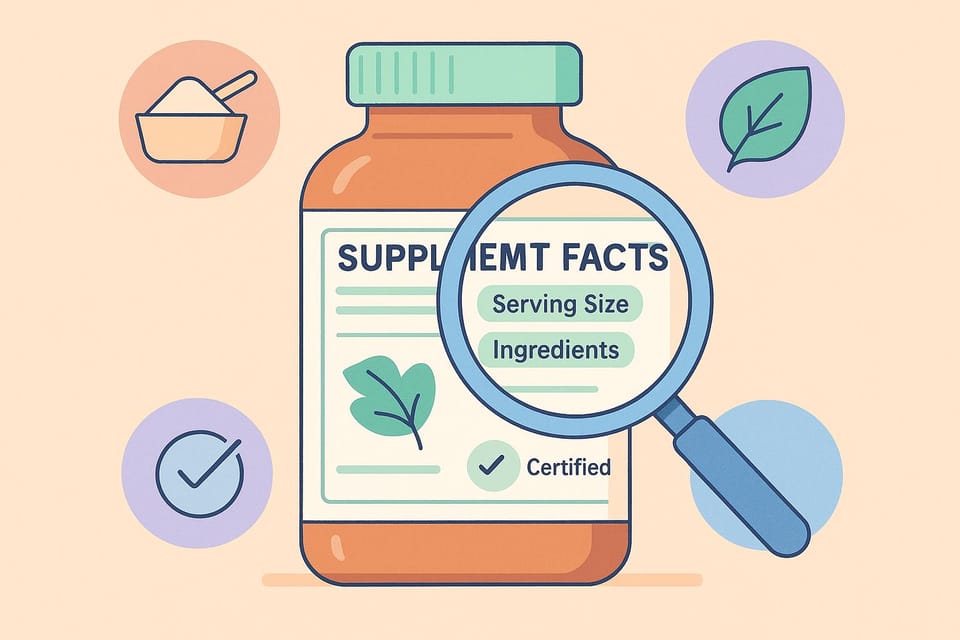
Confused by supplement labels? You’re not alone. Many supplements contain unlisted ingredients, misleading claims, or inadequate doses. A University of Florida study found nearly 40% of tested supplements were mislabeled or posed potential health risks.
Here’s what you need to know:
- Supplements lack FDA pre-market review. Manufacturers are responsible for safety and labeling, but without mandatory approval, the burden falls on consumers to verify product safety.
- Key label sections include:
- Principal Display Panel: Front of the bottle with the product name and claims.
- Supplement Facts Panel: Serving sizes, ingredient amounts, and % Daily Value.
- Other Information Panel: Warnings, storage instructions, and manufacturer details.
- Watch for red flags: Exaggerated health claims, proprietary blends hiding ingredient amounts, and missing third-party certifications.
- Certifications matter: Look for seals from USP, NSF, or ConsumerLab to ensure quality and safety.
Quick Tips:
- Check serving sizes and % Daily Value to avoid overdosing.
- Prioritize supplements with transparent ingredient lists and minimal fillers.
- Avoid products with vague terms like "natural" unless backed by certifications.
Pro Tip: Use tools like SlipsHQ to evaluate supplements for safety, quality, and value. It simplifies label reading and ensures you’re making informed choices.
Your health matters - choose wisely.
The Structure of a Supplement Label
Understanding how a supplement label is organized is crucial before diving into its specific parts. In the U.S., supplement labels follow a standardized format set by the FDA, ensuring consumers can easily find key details about the product. Every label must include sections that outline the product's contents, usage instructions, and manufacturer information, helping buyers make informed decisions. Here's a closer look at these sections.
Main Label Sections
Supplement labels typically have three main panels. The first is the principal display panel, which is the front of the bottle. This is where you'll find the product name, brand, and any marketing claims about the supplement's benefits. Since this space is designed to grab attention, it's important to evaluate claims with a critical eye.
The Supplement Facts panel is where you'll find the specifics, like serving size and ingredient details. Unlike the Nutrition Facts panel on food products, this section is tailored for supplements and provides regulated, accurate information.
The third panel is usually located on the back or side of the bottle. It includes directions for use, storage instructions, health warnings, and manufacturer contact details. While this panel might also feature extra marketing content or references to studies, it tends to be less strictly regulated. Look for clear manufacturer information, such as the company's name, address, and contact details (phone number or website). If this information is missing or hard to locate, it could be a red flag about the product's credibility.
Supplement Facts vs. Nutrition Facts
It's important to understand the difference between the panels used for supplements and those used for conventional foods. The Supplement Facts panel is specifically designed for dietary supplements, accommodating ingredients that might not have FDA-established daily values. For instance, many herbal extracts don’t have set daily values but still list precise amounts.
Supplement Facts panels often include sourcing details, such as an ingredient described as "as folic acid" or "from Calcium Alpha-Ketoglutarate", giving you a better idea of the nutrient's form. They also omit nutrients present in zero amounts, whereas food labels must list even trace amounts of certain nutrients.
Nutrition Facts panels, found on food products, follow a different set of rules. They are required to list specific nutrients, even in minimal quantities, and don't typically include detailed sourcing information.
Knowing these differences helps when comparing dietary supplements to fortified foods or evaluating your total nutrient intake. Always check for the Supplement Facts panel when reviewing a supplement - it signals that the product meets different regulatory standards than conventional foods.
How to Read the Supplement Facts Panel
The Supplement Facts panel is your go-to guide for understanding serving sizes, ingredient amounts, and how a supplement fits into your daily nutritional needs. By learning to interpret this information, you can make smarter choices about what you’re putting into your body and whether a supplement delivers on its promises. Let’s break it down, starting with the basics.
Serving Size and Servings Per Container
The first thing to check is the serving size. This tells you exactly how much of the product you should take in one dose - whether it’s a capsule, tablet, scoop of powder, or a specific liquid measurement. Every other figure on the label, like nutrient amounts, hinges on this serving size, so getting this part right is crucial.
For example, if a supplement’s serving size is two capsules and it lists 500 mg of an ingredient per serving, taking just one capsule means you’re only getting 250 mg - half the intended dose.
Right below the serving size, you’ll see "Servings Per Container", which tells you how many doses are in the entire package. If a bottle contains 60 capsules and the serving size is two capsules, it’ll last you 30 days if you stick to the recommended daily dose. This info is handy for comparing products since fewer servings per container might mean a higher cost per dose.
Always double-check these details and adjust your calculations based on the serving size to avoid any surprises.
What Percent Daily Value (%DV) Means
Once you’ve nailed down the serving size, the next step is to understand the %DV, or Percent Daily Value. This handy measure shows how much of a nutrient you’re getting compared to the FDA’s daily recommendations, based on a 2,000-calorie diet.
Here’s how it works: The %DV is calculated by dividing the amount of a nutrient in one serving by its daily reference value, then multiplying by 100. For instance, if a supplement contains 60 mg of vitamin C and the daily reference value is 90 mg, that serving provides 67% of your daily intake.
The %DV is a quick way to gauge whether a nutrient amount is low, moderate, or high. A value of 5% or less is considered low, while 20% or more is high. This can help you decide if a supplement aligns with your dietary needs.
However, not all ingredients have established daily reference values. When you see a dash ( - ) in the %DV column, it means the FDA hasn’t set a recommended intake for that nutrient. In such cases, you might need to dig deeper to determine the right dosage for you. Keep in mind, the %DV is based on general guidelines and may not reflect your specific nutritional needs.
Safe Dosage Levels and Upper Limits
Understanding safe dosage levels is essential to avoid overloading your system with certain nutrients. Upper Limits (ULs) represent the highest daily amount of a nutrient that’s unlikely to cause harm in healthy adults. Before buying a supplement, it’s wise to check the UL for key ingredients to ensure you’re staying within safe boundaries.
This is especially important for fat-soluble vitamins like A, D, E, and K, which can build up in your body over time, and for minerals like iron, zinc, and selenium. For example, exceeding the UL for fat-soluble vitamins or certain minerals could lead to negative health effects.
Don’t forget to factor in nutrients from your diet. If you’re taking a multivitamin that provides 100% DV for several nutrients and eating a balanced diet, you could end up consuming more than you need. Consulting a healthcare provider is always a smart move, particularly if you’re on medications or have health conditions. For instance, high doses of vitamin K can interfere with blood-thinning medications, and too much calcium might reduce the absorption of some antibiotics.
Supplement labels can sometimes be tricky to read. You might see something like "231 mg of calcium (from Calcium Alpha-Ketoglutarate)" alongside "1,100 mg of calcium alpha-ketoglutarate." In this case, the 231 mg refers to the elemental calcium you’re getting, while the 1,100 mg is the total weight of the compound. Understanding these distinctions is key to knowing exactly what you’re consuming.
Finally, check the "Other Ingredients" section at the bottom of the label. This is where you’ll find additives like binders, fillers, preservatives, sweeteners, or artificial colors. A long list of additives might indicate a lower-quality product, so it’s worth paying attention to this part of the label too.
How to Evaluate Ingredient Lists
The ingredient list on a supplement label is like a window into the product's actual composition. It goes beyond the Supplement Facts panel, showing you exactly what you're consuming and whether the manufacturer is being upfront about their formula. Learning how to interpret this information can help you identify high-quality supplements and avoid products that cut corners.
How Ingredients Are Listed by Weight
Ingredients are always listed in descending order by weight, which means the first ingredient on the list is the most abundant. This simple rule can reveal a lot about the product you're buying. If you're paying for a turmeric supplement but see "cellulose" listed before turmeric extract, you're likely getting more filler than the active ingredient. On the flip side, when the active ingredients appear near the top of the list, it suggests the product is concentrated in the nutrients you're looking for.
This order matters even more when proprietary blends are involved. Proprietary blends group several ingredients together without disclosing how much of each is included. For instance, if a "proprietary blend" is listed as the first ingredient with a total weight of just a few grams, it’s clear the blend dominates the product, but you won’t know the exact amounts of the individual components. When comparing two similar supplements, prioritize the one where active ingredients, like "ascorbic acid" in a vitamin C supplement, appear higher on the list, as it likely delivers a more potent dose.
Identifying Fillers, Additives, and Proprietary Blends
Once you understand the ingredient order, it's time to dig into the extras - fillers, additives, and blends. Fillers and additives are often used to cut costs, add bulk, or improve shelf life. While these ingredients aren’t inherently harmful, an extensive list of them can indicate a lower-quality product.
Common fillers include cellulose, maltodextrin, and silicon dioxide, while artificial colors, sweeteners like aspartame or sucralose, and flavorings often appear in the "Other Ingredients" section at the bottom of the label. A supplement with minimal additives is generally a better choice than one loaded with unnecessary extras.
Proprietary blends, on the other hand, can be a red flag. These blends combine multiple ingredients but only disclose the total weight, leaving you guessing about individual amounts. For example, a "Joint Support Blend – 500 mg" might include glucosamine, chondroitin, and turmeric, but you won’t know if glucosamine makes up 400 mg or just 50 mg of that total. This lack of transparency makes it hard to know if you're getting effective doses of the nutrients you want.
To avoid this, look for supplements that clearly list the amounts of each ingredient. This transparency shows confidence in the product's formulation and lets you make informed decisions. If you see a proprietary blend, it’s often a sign to look elsewhere for a product with clearer labeling.
Understanding Misleading Label Terms
Supplement labels are often filled with persuasive terms like "natural," "organic," or "all natural." While these phrases sound reassuring, they’re not always as meaningful as they seem. For instance, the FDA doesn’t strictly define "natural" for supplements, so manufacturers can use the term freely. Similarly, "all natural" is mostly a marketing phrase with no official regulatory backing.
The term "organic" carries more weight, as it must meet USDA certification standards. Ingredients with the USDA organic seal are grown without GMOs, synthetic fertilizers, or pesticides. However, while organic certification ensures specific farming practices, it doesn’t guarantee the supplement’s safety, purity, or effectiveness.
Instead of relying on vague terms, focus on verifiable quality markers like third-party testing certifications. Seals from organizations such as USP (United States Pharmacopeia), NSF (National Sanitation Foundation), GMP (Good Manufacturing Practices), or ConsumerLab provide more concrete evidence of quality. For example:
- USP certification confirms the supplement has been tested for strength, quality, purity, and consistency.
- NSF certification ensures the product contains the listed ingredients in the stated amounts and is free from harmful contaminants. NSF also screens sports supplements for 280 banned substances.
- GMP certification verifies the supplement was manufactured under strict quality controls.
If you're struggling to decode labels, tools like SlipsHQ can make the process easier. This app uses a science-based evaluation system to rate over 200,000 supplements, giving each one a score from 0 to 100 based on factors like safety, quality, and transparency. Its transparency rating specifically highlights issues like proprietary blends and unclear labeling, helping you quickly assess whether a product meets your standards.
When you see terms like "natural" or "all natural" without any third-party certification, treat them as marketing buzzwords rather than guarantees of quality. Instead, prioritize supplements with independent testing and clear ingredient disclosures. This approach ensures you're making informed choices about what you're putting into your body.
How to Spot Quality and Safety Markers
Once you've mastered reading labels and identifying marketing tricks, it's time to focus on the markers that ensure quality and safety. These include third-party certifications, expiration dates, and other key details that reflect a manufacturer's dedication to producing reliable products.
Third-Party Testing and Certifications
Third-party certifications are one of the best ways to confirm that a supplement contains what it claims - and nothing it shouldn’t. Since the FDA doesn’t pre-approve supplements before they hit the shelves, independent testing organizations step in to verify quality through rigorous lab analysis. Look for seals from trusted names like USP (United States Pharmacopeia), NSF International, ConsumerLab, BSCG, UL, or IFOS. These certifications show that the manufacturer voluntarily submitted their product for testing and met stringent standards.
NSF International stands out for its thorough approach. They test products in their accredited labs, conduct annual audits, and periodically retest certified supplements to ensure they continue meeting quality benchmarks.
For athletes - or anyone concerned about banned substances - the NSF Certified for Sport® mark is especially valuable. It screens for 280 substances prohibited by major sports organizations. Even if you’re not an athlete, the standard NSF seal or the USP-verified mark is worth seeking out, as they confirm the product meets established standards for purity and potency.
The importance of third-party testing becomes clear when you consider a study of 18 supplements. It found that 27.8% (5 out of 18) contained unlisted ingredients and were mislabeled. However, none of the certified supplements showed these issues. Among the 13 correctly labeled products, 76.9% were deemed safer or less risky for consumers.
If a certification seal isn’t on the label, check the manufacturer’s website for a Certificate of Analysis (COA). Many companies now include QR codes linking directly to testing results. If the COA isn’t easily accessible, a reputable manufacturer will provide it upon request.
If navigating certifications feels overwhelming, tools like SlipsHQ can help. This app scores supplements on a 0–100 scale based on factors like Safety, Efficacy, Quality, Transparency, and Value. It uses data from certifications and testing practices to simplify your decision-making process.
Expiration Dates and Manufacturer Details
Expiration dates are more than just numbers - they tell you how long a supplement will remain effective and safe. Over time, exposure to heat, light, or moisture can degrade the product or even create harmful compounds. Always check the expiration date before buying, and store your supplements as instructed - usually in a cool, dry place away from direct sunlight.
The label should also include detailed manufacturer information. Reliable companies provide a full name, physical address, phone number, and often a website or email address. This transparency makes it easy to trace the product’s origin or contact the company with any questions. Be cautious if the label only lists a P.O. box or lacks contact details altogether - it’s a potential red flag.
Batch numbers or lot codes are another sign of quality. These codes track specific production runs, showing the manufacturer follows proper quality control procedures. Additionally, check if the company complies with Good Manufacturing Practices (GMP). While all supplements in the U.S. must adhere to FDA-enforced Current Good Manufacturing Practices (CGMPs), some manufacturers go a step further by obtaining third-party GMP certification, offering extra peace of mind.
Warning Labels and Disclaimers
Every supplement in the U.S. is required to carry an FDA disclaimer stating that the product’s claims haven’t been evaluated by the FDA and that it isn’t intended to diagnose, treat, cure, or prevent any disease. This disclaimer is mandatory and distinguishes supplements from medications.
Beyond the standard disclaimer, pay close attention to warning labels. These often highlight potential side effects, interactions with medications, or risks for certain groups. For instance, warnings for pregnant or nursing women are especially important, as some ingredients could impact fetal development or pass into breast milk. If you’re pregnant, nursing, or planning to become pregnant, consult your healthcare provider before starting any supplement.
Allergen warnings are another critical detail. If a supplement is made in a facility that handles common allergens like soy, dairy, shellfish, or tree nuts, this should be clearly stated on the label.
Transparent and thorough warning labels are a sign of a trustworthy product. A supplement that provides clear safety details, comprehensive manufacturer information, and evidence of third-party testing is far more reliable than one with vague or missing warnings. Paying attention to these markers helps you make informed choices and prioritize your health.
Warning Signs of Low-Quality Supplements
Even with clear indicators of quality, certain warning signs can help you spot low-quality supplements that might not only waste your money but also pose potential health risks.
Unrealistic Health Claims
While the presence of an FDA disclaimer is a good starting point, exaggerated health claims can be a major red flag. By law, supplements cannot claim to "diagnose, treat, cure, or prevent any disease" - this is a standard reserved for FDA-approved drugs. However, some manufacturers push the boundaries with claims that go far beyond acceptable structure-function statements like "supports bone health" or "helps maintain strong bones." If these claims are paired with testimonials or flashy before-and-after photos but lack the required FDA disclaimer, it's time to question their legitimacy. Tools like SlipsHQ can help you determine whether a supplement’s claims are supported by science or just marketing fluff.
Price is another area where caution is warranted.
Unusually Low Prices and Missing Certifications
The price tag of a supplement can often reveal a lot about its quality. Extremely low prices might suggest cost-cutting measures, such as using cheap fillers instead of high-quality ingredients. Reliable supplements are generally verified by independent organizations like USP, NSF, or ConsumerLab. These certifications involve rigorous testing to confirm that the ingredients listed on the label match what's inside the bottle. For example, less than 5% of supplement brands earn the NSF Certified for Sport® designation, highlighting the stringent standards required for this certification. If a supplement is priced significantly lower than certified alternatives, it’s worth questioning whether corners were cut during production.
Unclear Ingredient Sources
Transparency about ingredient sourcing is another critical factor. High-quality supplements provide detailed information about their ingredients, including the specific type (e.g., "as folic acid") and the part of the plant used. If this level of detail is missing, it becomes difficult to verify the authenticity and potency of the ingredients. Additionally, proprietary blends that don’t disclose exact ingredient amounts can obscure important details about what you're consuming. Trustworthy products also include comprehensive manufacturer information, such as the company name, address, phone number, and website, so you can verify their legitimacy. If a supplement lacks clear details about its ingredients or the manufacturer, it’s a strong signal to look elsewhere.
Conclusion: Making Informed Choices
Understanding supplement labels is essential for your safety and ensuring you're getting what you pay for. Since supplements aren't as tightly regulated as pharmaceuticals, it's up to you to make informed decisions about what you consume.
Key Tips for Reading Supplement Labels
Here’s how to evaluate supplement labels effectively:
- Start with the Supplement Facts panel: Look at the serving size, calculate the dosage, and consider how long the product will last. Pay attention to the %Daily Value to avoid exceeding safe limits, especially with fat-soluble vitamins, which can accumulate in the body.
- Check the ingredient list: Ingredients are listed in descending order by weight. If fillers dominate the list, you're likely paying more for bulk than for the active components. Be wary of exaggerated claims and look for FDA disclaimers. Terms like "all natural" or "organic" may sound reassuring but aren't strictly regulated by the FDA, so they don't guarantee safety or quality.
- Look for third-party testing certifications: Certifications from groups like NSF International, USP, or ConsumerLab ensure the product contains what it claims and is free from harmful contaminants. For example, less than 5% of supplement brands achieve the NSF Certified for Sport® designation. A study of 18 supplements found that five were misbranded with unlisted ingredients, and none had undergone third-party testing; only 10 were deemed "likely okay" for health.
- Verify expiration dates and manufacturer details: Reputable companies provide clear contact information, allowing you to confirm their legitimacy and ask questions if needed.
How SlipsHQ Simplifies Supplement Selection
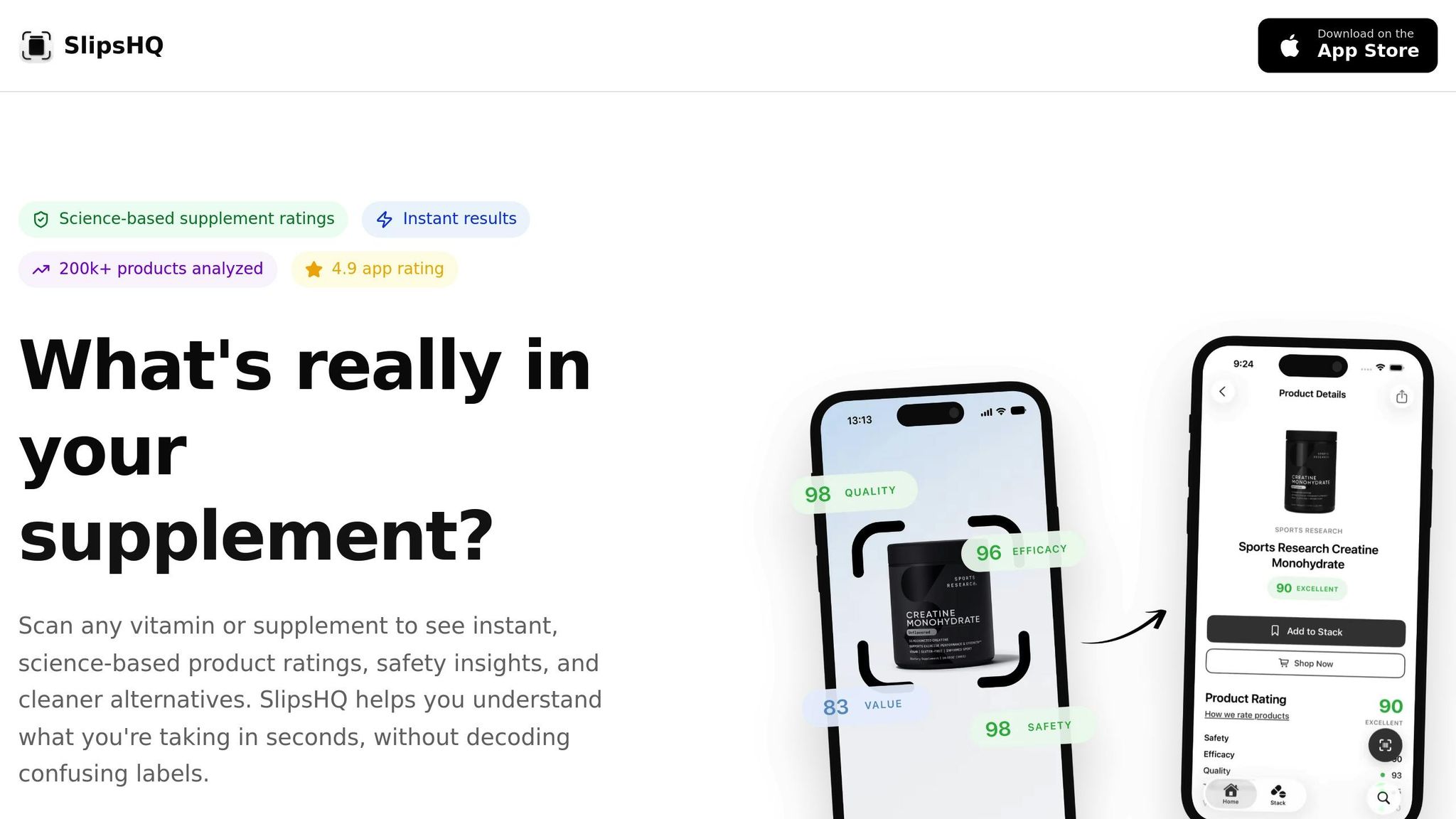
SlipsHQ takes the guesswork out of choosing supplements by offering a science-backed evaluation system. With a quick barcode scan, the app provides a product score (from 0 to 100) based on factors like Safety, Efficacy, Quality, Transparency, and Value. It also breaks down each ingredient, explains its purpose, reviews supporting evidence, and flags potential risks.
The app includes safety alerts for high-risk ingredients, stimulant-heavy formulas, and possible drug interactions. It even calculates price-per-serving and compares retailers, helping you find true value without falling for marketing hype.
SlipsHQ operates independently - it doesn’t sell supplements, accept paid placements, or adjust ratings for profit. Instead, its scores rely on objective data, certifications, testing practices, and rigorous ingredient standards. With a 4.9 app rating and thousands of users across the U.S. and Canada, it’s become a trusted resource for health-conscious shoppers.
Beyond evaluations, SlipsHQ helps you manage your supplement routine. You can track what you’re taking, avoid ingredient overlaps, and optimize your regimen. The app offers a 3-day free trial, with subscriptions starting at $4.99 per week or $39.99 annually - a small price for making smarter, healthier choices.
FAQs
Why should I check for third-party certifications on supplement labels?
Third-party certifications play an important role in ensuring the quality of supplements. These certifications confirm that the product includes the ingredients listed on its label and adheres to established safety and quality standards. They also verify that the supplement is free from harmful contaminants, such as heavy metals or prohibited substances.
Choosing supplements with reliable certifications gives you more confidence in their purity, strength, and safety. This extra assurance can help you make smarter, more informed decisions when it comes to your health.
How can I spot and avoid supplements with false claims or hidden ingredients?
When choosing supplements, it’s crucial to steer clear of those with overblown health claims or hidden ingredients. The key is transparency. Always check for clear ingredient lists, accurate dosages, and certifications from trustworthy organizations.
A tool like SlipsHQ can make this process much easier. It offers science-based insights into supplement safety, ingredient quality, and potential risks, empowering you to make smarter choices. Be wary of products that lean on proprietary blends, as they often fail to provide a detailed breakdown of their ingredients.
How do I read the serving size and % Daily Value on a supplement label?
When examining a supplement label, the serving size is the first thing to check. This tells you the amount considered a single serving - whether it's one capsule, one scoop, or another specified measurement. All the nutrient details on the label are based on this serving size, so if you take more or less than what's listed, you'll need to adjust the numbers accordingly.
Next, pay attention to the % Daily Value (%DV) for each nutrient. This figure shows the percentage of your daily recommended intake provided by one serving. For instance, if a nutrient has a %DV of 50%, that serving covers half of your daily requirement. It's worth noting that these percentages are based on a 2,000-calorie diet and might not align with your specific nutritional needs. If you're uncertain about the right dosages for your situation, it's always a good idea to consult a healthcare professional.