
How to Verify Supplement Certifications
Want to ensure your supplements are safe and effective? Start by checking for third-party certifications. Unlike prescription drugs, supplements aren’t closely regulated by the FDA, so certifications from organizations like USP, NSF, or ConsumerLab are key to verifying quality, safety, and label accuracy.
Key Steps to Verify Supplement Certifications:
- Look for Certification Seals: Check the label for seals like USP Verified or NSF Certified for Sport. Avoid fake seals with blurry logos or vague claims like “FDA Approved.”
- Use Official Databases: Confirm the product’s certification on trusted websites like USP.org or NSF.org. Match details like brand, dosage, and batch number.
- Scan Barcodes with Apps: Tools like SlipsHQ let you scan barcodes for instant certification info, safety warnings, and ingredient analysis.
- Spot Red Flags: Avoid products with exaggerated claims (e.g., “cures cancer”) or missing label details like lot numbers or expiration dates.
Certifications ensure the product meets strict standards for purity, potency, and safety. For athletes, seals like NSF Certified for Sport also screen for banned substances. Always verify certifications to avoid harmful contaminants or mislabeled products.
Step 1: Find Certification Seals on Supplement Labels
When evaluating supplements, start by checking the bottle for third-party certification seals. These seals should be easy to spot on the label. Begin with the principal display panel (usually the front of the bottle), then inspect the back or side panels. If a seal is hidden or hard to find, consider it a warning sign. Here's how to identify legitimate seals and avoid being misled by fakes.
What Legitimate Certification Seals Look Like
Authentic certification seals are professionally printed and feature official logos. For instance, the NSF seal includes a clear blue "NSF" mark accompanied by text like "NSF Certified" or "Certified for Sport." Similarly, the USP seal displays a black-and-white shield labeled "Verified Dietary Supplement." These seals often include additional verification details such as a lot number, registration ID, or even a QR code that links to the certifier's website. Some seals may have special features like embossing or foil stamping - tilt the bottle under light to spot holograms or metallic accents. Look closely at the printing quality; it should be sharp, free of smudges, and without grammatical mistakes.
Warning Signs of Fake or Misleading Seals
Spotting fake seals is easier than you might think. Low-resolution printing, blurry logos, or text that's difficult to read are immediate red flags. Be cautious of seals that mimic established certifications, such as a logo resembling "NSF" but spelled as "NSR." Generic designs like a plain starburst with vague phrases like "Quality Tested" and no reference to a certifying organization are also suspicious. Missing information, such as batch numbers, URLs, or registration codes, is another indicator of a counterfeit. Lastly, avoid products with seals claiming "FDA Approved" - the FDA does not certify dietary supplements. If a seal looks generic or unprofessional, it's best to steer clear of that product.
Step 2: Check Certifications Using Official Databases
Once you spot a certification seal on a product, the next step is to confirm its legitimacy. This means using the certifier's official database to verify the claim. This process helps you steer clear of products with false or misleading certifications. Let’s break down how to navigate these certification websites effectively.
How to Use Certification Websites
Start by visiting the certifier's official website and using their search tool to locate your product. For example:
- USP Verified Supplements: Go to the USP Dietary Supplement Verification Program section. There, you can search by brand name, product name, or category (e.g., "fish oil" or "multivitamin").
- NSF Certified Products: The NSF website offers separate databases for standard dietary supplement certifications and the NSF Certified for Sport® program. Select the database that matches the seal on your product, then search using the brand, product name, or certificate number.
- ConsumerLab Seals: Visit ConsumerLab.com to explore their tested product listings. You can search by brand, product name, or ingredient. While basic approval details are accessible to non-members, full test reports often require a paid subscription.
To ensure a precise match, gather key product details beforehand. This includes the brand name, product name, dosage strength, dosage form, flavor or variant, and the UPC barcode. Having this information handy is especially helpful when brands offer multiple formulations or strengths under similar names.
Which Product Details to Match
When you locate your product in the database, it’s critical to confirm every single detail against your label. The brand name, product name, dosage form, and strength must align perfectly. For instance, if the database lists a 500 mg tablet and your bottle contains 1,000 mg capsules, it’s not a match - even if the brand and general product name are identical. Pay close attention to specific flavors or variants, as certifications often apply to individual SKUs. An "Orange Chewable" version might be certified, while an "Unflavored" one is not.
For additional verification, check the lot numbers, batch codes, and expiration dates printed on your product. These identifiers are typically found near the bottle bottom, cap, or side seam, labeled as "Lot", "Batch", or as a mix of letters and numbers, along with an "EXP" or "Best by" date. Third-party certifiers usually evaluate specific production runs, so if your batch falls outside the certifier’s listed range, it may not meet the same standards. This is especially important if the manufacturer has changed the formulation or production process for later batches.
If you can’t find your product in the database despite the seal, contact the certifier directly. Provide them with a photo of the product, its lot number, and the UPC. You can also reach out to the product manufacturer and request up-to-date certification documentation. Until you have clarity, it’s safer to opt for a supplement that’s clearly listed as certified in the database.
Step 3: Use Barcode Scanning Apps for Quick Verification
Manually sifting through certification databases can be a tedious process. Barcode scanning apps simplify this by providing instant access to certification details, safety information, and quality ratings. This method not only saves time but also makes verifying supplements far more efficient.
How SlipsHQ Simplifies Certification Checks
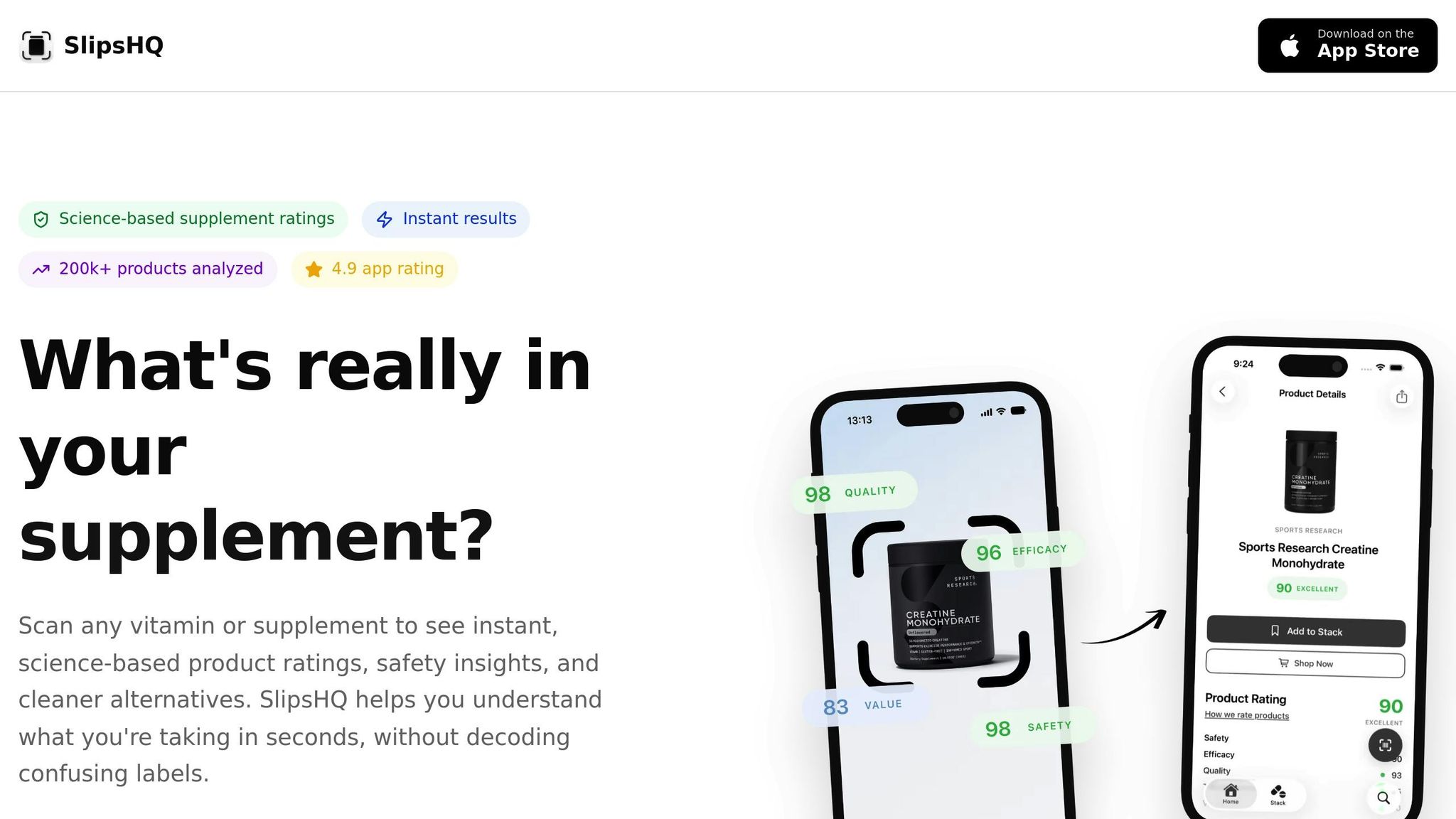
SlipsHQ transforms your smartphone into a powerful supplement scanner. Just open the app, scan the product's barcode, and get immediate access to its certification details - such as NSF or USP certifications. The app pulls data directly from official databases to verify claims, ensuring compliance with FDA's 21 CFR 111 standards, which cover identity, purity, and contaminant levels.
Beyond certifications, SlipsHQ provides a trust score that evaluates supplements across five key areas: Safety, Efficacy, Quality, Transparency, and Value. This score is based on data like certification validity, ingredient purity, and any safety warnings. For instance, scanning an NSF Certified for Sport supplement will confirm it has been tested for over 280 banned substances and flag any issues, such as undeclared contaminants. The app also offers personalized supplement stack suggestions, price comparisons from various retailers, and detailed ingredient analyses.
Why Apps Are Essential for Supplement Verification
Apps like SlipsHQ take the hassle out of manual verification. Instead of navigating multiple certification websites, the app consolidates real-time results from certified labs into one convenient platform. This reduces the chances of missing crucial details, such as discrepancies in product potency or hidden contaminants. With a database of over 200,000 supplements and a stellar 4.9 app rating, SlipsHQ provides a reliable solution in a market where independent verification is crucial. The app offers a 3-day free trial, followed by a subscription of $4.99 per week or a one-time payment of $20 for lifetime access - offering peace of mind about what you’re putting into your body.
Step 4: Spot and Avoid Red Flags in Supplement Claims
Common Warning Signs to Look For
Even if a supplement has certification seals, certain red flags can signal misleading or even dangerous products. Be cautious of supplements claiming to "cure cancer", "reverse heart disease overnight", or "melt fat effortlessly." In the U.S., dietary supplements are prohibited from claiming to diagnose, treat, cure, or prevent diseases. Such statements not only violate FDA regulations but also suggest poor manufacturing standards. Watch out for terms like "miracle cure", "works for everyone", "100% safe and natural", or "no side effects" - these are often flagged by the FDA as high-risk marketing tactics. Beyond exaggerated claims, missing or incomplete label details can also be a red flag.
Check the label carefully. If key information like the Supplement Facts panel, manufacturer details, lot number, or expiration date is missing, the product might be questionable. Be wary of "proprietary blends" that don’t disclose ingredient amounts. Poor print quality, frequent typos, or inconsistencies between labels on bottles of the "same" product can signal poor quality control - or even counterfeiting.
Pay attention to questionable ingredients. Undisclosed blends that hide high doses of stimulants or risky combinations are a major concern. Excessive amounts of fat-soluble vitamins or minerals like iron can lead to toxicity. Supplements marketed for sports performance, sexual enhancement, or weight loss often list drug-like or obscure chemical names, which may indicate hidden prescription drugs or banned substances. Certifications like NSF Certified for Sport® help identify safer options in these categories.
How to Report Suspicious Products
If you spot these red flags, taking action is essential. Start by reporting the product to the FDA. Gather details like the product name, brand, lot number, expiration date, purchase information, and clear photos of all labels. For serious side effects, submit FDA Form 3500 through MedWatch. For issues such as fake certification seals or illegal claims, use the FDA Safety Reporting Portal. If possible, keep the product in a safe place, as the FDA may request it for testing.
You can also notify certifying organizations like NSF, USP, or ConsumerLab if a certification seal appears to be misused. These groups can investigate and revoke certifications if necessary. For deceptive advertising, particularly online or on social media, file a complaint with the Federal Trade Commission (FTC), which monitors truth-in-advertising for supplements. Tools like SlipsHQ, a barcode-scanning app, can help you quickly identify missing certifications, risky ingredients, or safety alerts. Save any screenshots or reports to include in your complaint to the FDA or certifying organizations.
Step 5: Compare Major Certifications
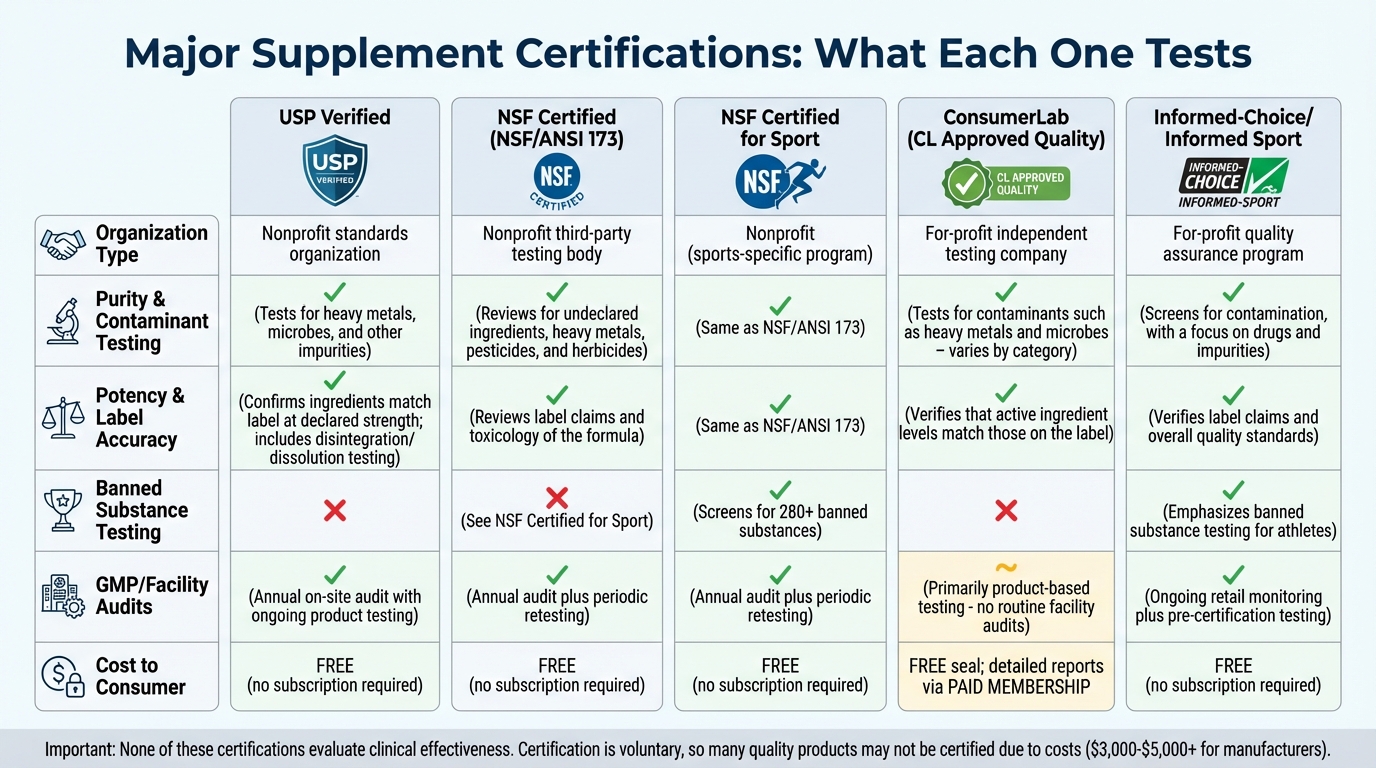
Supplement Certification Comparison: USP, NSF, ConsumerLab, and Informed-Choice
Certification Comparison Table
When it comes to supplement certifications, not all seals are created equal. Each certification has its own focus, testing criteria, and limitations. Understanding what these certifications cover - and what they don’t - can help you make informed choices about the supplements you use. In the U.S., the four main third-party certifiers are USP Verified, NSF Certified, ConsumerLab, and Informed-Choice. Let’s break down what sets them apart.
USP Verified and NSF Certified are managed by nonprofit organizations. Both conduct annual facility audits and continuous product testing, but their approaches differ slightly. USP Verified ensures that a product contains the listed ingredients at the stated strength and is free from harmful levels of contaminants like heavy metals and microbes. On the other hand, NSF Certified focuses on label claims, toxicology, and undeclared ingredients. However, it only screens for sports-banned substances if the product carries the NSF Certified for Sport mark, which tests for over 280 banned substances. These certifications can be expensive for manufacturers - costing between $3,000 and $5,000 or more - so many quality supplements may lack these seals.
ConsumerLab takes a different route. As a for-profit company, it independently purchases supplements directly from store shelves and tests them for label accuracy, potency, and contaminants. Products that pass earn the CL Approved Quality seal. Manufacturers pay between $300 and $3,500 for testing, while consumers can access detailed reports through a subscription.
Informed-Choice (and its sports-focused counterpart, Informed Sport) is geared toward athletes and others subject to drug testing. These for-profit programs verify label claims and screen for banned substances through pre-certification testing and ongoing retail monitoring. While they don’t assess clinical effectiveness, they are invaluable for avoiding unintentional doping. Like USP and NSF certifications, the cost is absorbed into the product price, so consumers don’t pay extra for the seal.
Here’s a quick side-by-side comparison of these certifications:
| Certification | Organization Type | Main Focus | Purity & Contaminant Testing | Potency & Label Accuracy | Banned Substance Testing | GMP / Facility Audits | Cost to Consumer |
|---|---|---|---|---|---|---|---|
| USP Verified | Nonprofit standards organization | Identity, strength, quality, and purity | Tests for heavy metals, microbes, and other impurities | Confirms ingredients match label at declared strength; includes disintegration/dissolution testing | No | Annual on-site audit with ongoing product testing | Free seal; no subscription required |
| NSF Certified (NSF/ANSI 173) | Nonprofit third-party testing body | Label accuracy, safety, and manufacturing quality | Reviews for undeclared ingredients, heavy metals, pesticides, and herbicides | Reviews label claims and toxicology of the formula | No (see NSF Certified for Sport) | Annual audit plus periodic retesting | Free seal; no subscription required |
| NSF Certified for Sport | Nonprofit (sports-specific program) | Athlete safety and doping risk reduction | Same as NSF/ANSI 173 | Same as NSF/ANSI 173 | Yes – screens for 280+ banned substances | Annual audit plus periodic retesting | Free seal; no subscription required |
| ConsumerLab (CL Approved Quality) | For-profit independent testing company | Independent comparative testing across brands | Tests for contaminants such as heavy metals and microbes (varies by category) | Verifies that active ingredient levels match those on the label | No | Primarily product-based testing (no routine facility audits) | Free seal; detailed reports via paid membership |
| Informed-Choice / Informed Sport | For-profit quality assurance program | Sports nutrition safety and quality assurance | Screens for contamination, with a focus on drugs and impurities | Verifies label claims and overall quality standards | Yes – emphasizes banned substance testing for athletes | Ongoing retail monitoring plus pre-certification testing | Free seal; no subscription required |
It’s important to note that none of these certifications evaluate the clinical effectiveness of a supplement. Certification is also voluntary, meaning many high-quality products may skip the process because of the costs involved. Additionally, even certified products aren’t completely risk-free - taking excessive doses, combining them with medications, or using them with certain health conditions can still pose dangers.
For a faster way to check certifications, tools like SlipsHQ can be a game-changer. By scanning a product’s barcode, it provides a simple trust score, highlights any safety warnings, and flags potential interaction risks. This can be especially handy when comparing products in-store or online.
Conclusion
Checking supplement certifications doesn’t have to be complicated. Start by looking for legitimate certification seals on product labels, cross-checking items on trusted databases like NSF.org or USP.org, and using barcode scanning apps. Keep an eye out for suspicious claims and compare certifications to make smarter choices. These steps help you avoid products that might contain undeclared ingredients, harmful contaminants, or even heavy metals that could put your health at risk.
Certifications, backed by annual audits and regular testing, ensure that what’s on the label matches what’s in the bottle. Take NSF’s Certified for Sport program as an example - it screens for over 280 banned substances, offering athletes peace of mind and protection from accidental doping. Recent studies have shown that a surprising number of supplements fail to meet their label claims, underscoring just how important verification really is.
For a quicker, science-backed solution, you can turn to SlipsHQ. This app lets you scan a product’s barcode to instantly access a trust score, safety alerts, and insights into ingredient purity. With over 200,000 supplements analyzed and a stellar 4.9 app rating, SlipsHQ simplifies the process. It evaluates products on safety, quality, transparency, efficacy, and value - making it easier to choose supplements that genuinely support your health. It’s a powerful tool in navigating the often overwhelming supplement market.
FAQs
How can I check if a supplement’s certification is authentic?
To verify if a supplement’s certification is genuine, first identify the third-party organization that issued the seal. Then, head to their official website and compare the certification details with the information on the product's label. Check that the product name, batch number, or other identifiers match what’s listed in the certifier’s database.
For a more convenient approach, tools like SlipsHQ can help. This platform offers features like barcode scanning and trust scores based on scientific data, making it easier to check certifications and assess product transparency.
What can I do if my supplement isn’t listed in a certification database?
If your supplement isn’t included in a certification database, your first step should be contacting the manufacturer. They should be able to give you detailed information about the product’s certifications or the testing it has undergone.
You can also seek guidance from a trusted healthcare professional to better understand the supplement’s safety and effectiveness. For a deeper dive into the product’s quality, safety warnings, and ingredient transparency, tools like SlipsHQ can be incredibly helpful.
Why should I check supplement certifications with tools like SlipsHQ?
When it comes to picking supplements, checking certifications is a must. Tools like SlipsHQ make it easier to ensure the products you choose are safe, effective, and meet high-quality standards. These certifications confirm that supplements are tested for purity and accuracy, so you can feel confident about what you're putting into your body.
SlipsHQ takes the guesswork out of the process by offering science-backed insights into a supplement’s safety and quality. With features like barcode scanning and tailored recommendations, it helps you steer clear of misleading claims and make smarter choices for your health.